
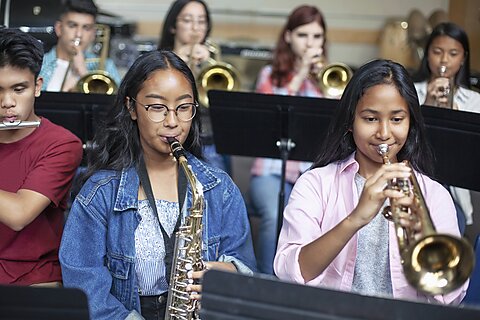









The New York Times tells us that tariffs on musical instruments are making prices so high that student musicians in many junior high school and high school bands and orchestras across the country can no longer afford instruments, nor can their budget-strapped schools afford to provide them. Tariffs on musical instruments are more than twice as high as they were in President Donald Trump’s first term, and some instruments now cost thousands of dollars.
As a result, Times reporter Sydney Ember explains, “Proponents of musical education say the tariffs are endangering school music programs and threatening to push the extracurricular activity out of reach for many families.”
This news takes me back to my teenage schooldays when I played first clarinet in Colonel John Blair’s “Marching and Fighting Greyhound Band” at Lyman High School in Longwood, Florida. Playing in the band was a family affair for all five Bacchus children. My three younger sisters played the saxophone, the bassoon, and the flute, and were also all state baton twirling champions as majorettes (a largely lost art nowadays). My younger brother played the trumpet for a while before he abandoned the band to become a quarterback on the football team. One of the trombone players became my brother-in-law. More than half a century later, I am still in touch with some of my classmates who played with me in the high school band.
Alas, I did not become another Benny Goodman or Artie Shaw. My days playing the clarinet are long behind me. Surely, if I tried to blow into the reed of a clarinet now, all that would come out would be a screechy squeak. And yet, I loved being in the band. And I learned in the band how much practice it takes in cooperating with others to produce harmony. Tacitly, that is a lesson I seem to have taken with me in all the years since, in all I have done publicly and privately, ever in search of ways to work alongside others to create more harmony in a discordant world.
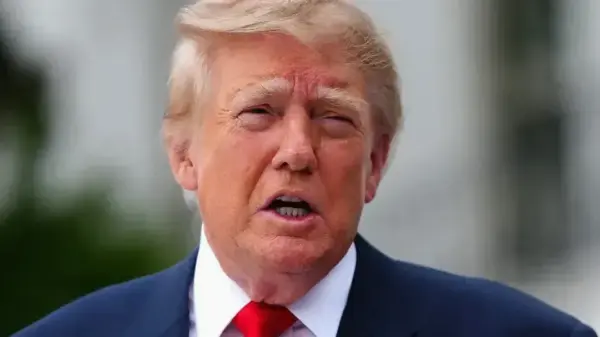
The Trump tariffs will prevent many other young Americans from learning these and other valuable lessons through musical education. The Trump administration (somehow with a straight face) sees the import of brass instruments such as trombones, tubas, and trumpets as a national security threat because they contain copper, a critical mineral. Although these musical instruments altogether comprise, as the Peterson Institute for International Economics has pointed out, only “a trivial share of US copper consumption” and higher tariffs would shift demand to US producers “only by a tiny fraction of a percent,” the Trump team sees Section 232 of the Trade Expansion Act of 1962 as an appropriate tool for levying more tariffs on imports of musical instruments to protect America’s children and the rest of us in this country from this supposedly dire threat.
I doubt it occurred to any of the five Bacchus children at the time to consider how much our parents paid for the musical instruments we played decades ago. Times were tight for us then, with my father ill and out of work and with my mother working as a nurse while scrambling to raise five children. The money they used to pay for our instruments must have led to financial sacrifices elsewhere in the family budget, probably in purchasing less of something for themselves. Somehow, they found the money.
But, with the skyrocketing prices of musical instruments today, fueled by these needless tariffs as well as by inflation, how many parents now will, like my parents, be able somehow to find that needed money?
How can we as a country possibly benefit from less music-making by young Americans? Reduced access to instruments that enable America’s children to learn how to make music – and how to cooperate to produce harmony – is one more example of how far-reaching the impacts of the ongoing avalanche of Trump’s tariffs have become. These impacts are increasingly extending into virtually every aspect of American life, reverberating throughout all that we do and all that we aspire to do.
The issue of tariffs may seem esoteric. It may seem a question solely for economists and for politicians who purport to understand economics. It is not. Tariffs are hidden taxes that are all too real. These taxes fall most heavily on those with lower incomes, on those who must scramble day by day to get by. Tariffs have real-world consequences – not only in higher prices, but also in how we live and in how we learn to live together. Colonel Blair is no longer with us and is sorely missed. But he would say the same.
James Bacchus is an adjunct scholar with the Cato Institute, a professor at the University of Central Florida, and a visiting professor at the London School of Economics. His most recent book is Democracy for a Sustainable World: The Path from the Pnyx, from Cambridge University Press.