


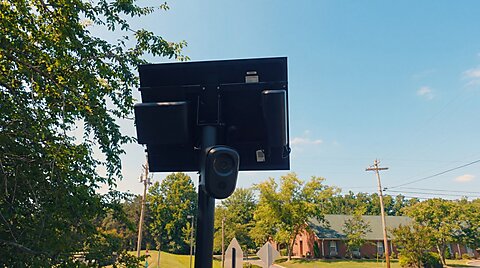















Recently, the proliferation of automated license plate readers (ALPRs)—led by private surveillance vendors like Flock, Axon, Motorola, and Verkada—has come under increased public scrutiny. Proponents of ALPRs—which I call “Flockers”—insist that the mass surveillance dragnet merely tracks public movements and is an indispensable crime-fighting tool. But Americans are rightly skeptical.
And late last month, a federal jury in San Antonio shot back at the “Flockers.”
On behalf of the Institute for Justice client, Alek Schott, 12 ordinary citizens found Bexar County liable for operating an unconstitutional mass-surveillance regime. The scheme was as predictable as it was abusive: ALPRs logged travel patterns and flagged a Houston father as suspicious. A sheriff’s deputy then manufactured a pretextual traffic violation on I‑35 to interrogate Schott, prolong his detention, and search his vehicle using a Probable Cause Creating (PCC) dog. The jury properly awarded Schott exactly what he asked for—$76, representing one dollar for each minute he was unlawfully detained.
The San Antonio verdict is an indictment of the modern mass surveillance dragnet, but it also highlights the profound importance jurors—drawn from the local community—play in adjudicating disputes between citizens and their government.
The facts of the Bexar County case put the reality of automated surveillance on full display. Automated surveillance vendors sell law enforcement an infrastructure predicated on a simple premise—one the Framers would have found repulsive: if you spy on enough people, crime may eventually decrease, and perpetrators can be more easily identified.
ALPR networks don’t merely compare plates against stolen-vehicle databases. They construct persistent records of everyday transit, mapping routes, routines, and associations. When police departments integrate these camera networks, completely mundane travel can be branded as suspicious.
Thanks to a Supreme Court that has greenlighted pretextual traffic stops, something as innocuous as an air freshener dangling from the rearview mirror, a busted taillight, or a driver/passenger failing to wear a seatbelt is sufficient to stop a vehicle. Officers can tail vehicles until a driver fails to signal, drifts over the double yellow line, or exceeds the speed limit—transforming minor traffic infractions into a fishing expedition. When drivers decline to consent to a search, officers can deploy PCC dogs to manufacture probable cause on command.
When the Bexar County Sheriff’s Department dismissed Alek Schott’s complaint, stating that their internal review found no policy violation and dared him to sue, they likely didn’t expect to have to defend their actions to a jury. That’s because the Supreme Court has confected a plethora of doctrines—including qualified immunity—that often keep cases like Schott’s from ever reaching a jury.
But the Framers didn’t view the civil jury as an afterthought. As Alexander Hamilton noted in Federalist No. 83, the right to a jury trial in civil suits against the government was conceived as an indispensable structural check against government overreach.
Ultimately, the civil jury was intended to impart local community standards and hold those who abuse their power accountable. The jury box remains one of the few institutional spaces where ordinary citizens directly wield authority over state actors.
The Bexar County verdict provides an actionable template for challenging ALPR dragnet operations nationwide. While much progress is being made across the country, reining in the mass surveillance dragnet cannot rely solely on legislative proposals or oversight hearings; it requires aggressive, strategic impact litigation that forces those responsible for government-orchestrated Ponzi schemes to justify their actions to twelve citizens in a federal courtroom.
Enforcing our federal civil rights laws can only be effective when jurors get to opine on matters of critical importance, as they did in Alek Schott’s case. While it’s incumbent upon Congress, state legislatures, and local governments to rein in—or even outright dismantle—the mass surveillance regime, there must be a way to hold those who abuse these systems accountable.
Accordingly, Congress must create an avenue to sue federal officials and do away with the judicially confected doctrines of qualified immunity for cops and absolute immunity for prosecutors. This would ultimately force the “Flockers” to have to defend their actions to a jury—something I surmise may lead to their inevitable and welcome downfall.