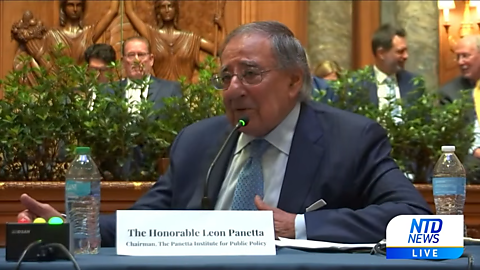
















On September 21, the House Budget Committee held a field hearing in Dallas, TX, on the need for a fiscal commission. My ears perked up when former Secretary of Defense Leon Panetta started speaking about BRAC, the Base Realignment and Closure Commission, as a model for overcoming politically difficult budget choices:
One of the successful commissions dealt with BRAC. And it’s an interesting issue to talk about because the reason BRAC came about is because members did not have the courage to step up and be able to support reducing military bases that were not needed.
So the BRAC commission was enacted in the Congress, and the BRAC commission had three different chapters. But in every one of them, the vote had to be up or down on the whole package. And it worked. It worked. BRAC worked.
I happen to have represented Fort Ord Military Reservation in my district. Fort Ord got BRAC’d. I don’t like it. But on the other hand, it was part of what needed to be done in order to discipline the budget.
So BRAC, I think, is a good example to keep in mind in developing this commission that will focus on the deficit.
Panetta is correct that BRAC was created because Congress found it too difficult to close military bases that were no longer needed. Members faced strong incentives to protect bases in their own districts and banded together to prevent any closures—even though most agreed there were too many, and they were a waste of taxpayer money.
The commission changed those incentives. With BRAC, Congress delegated the responsibility for identifying base closures to an expert commission and asked the president to approve the full package before sending it to Congress for review. Congress could do nothing, and the package would be automatically adopted. Legislators retained ultimate authority to reject the package in full and without amendments.
Importantly, there was no up- or down-vote on the final recommendations in Congress. Congress had veto power, but did not need to vote for the package before it could go into effect. I’ve previously referred to this as “silent approval.”
By distancing members of Congress from the recommendation-drafting stage and eliminating the need for legislators to affirmatively vote on politically sensitive changes, the BRAC process shifted blame to experts and made reform possible.
Critics charged that Congress abdicated its responsibilities with BRAC. Senator McCain (R‑AZ) explained:
The Congress has probably abdicated its responsibilities…. However, I would like to point out that it is very clear that we are at a condition of gridlock as far as base closings are concerned…history indicates that we are incapable of acting in any other way because of the enormous political repercussions which result in each of our States as a result of a move to close a base or a military installation.
Entitlement reform presents a far greater challenge than closing obsolete military bases did at that time, both substantively and politically.
Deciding which military bases are redundant is not the same as deciding how to close a growing fiscal gap, driven largely by unsustainable spending on Social Security, Medicare, and Medicaid. Entitlement reform involves much broader choices about eligibility, benefit design, and the distribution of reform costs.
Congress would need to provide clear instructions about what the commission should accomplish and the constraints it must operate within. Congress could establish a clear fiscal target, identify which programs are within the commission’s jurisdiction, set boundaries around policy changes, and establish oversight functions.
Seventy-one percent (71 percent) of respondents in a recent Cato poll favor creating a commission of independent experts and giving it the power to address Social Security’s funding shortfall. Support is broad across age and income groups, with Democrats most supportive (78 percent), followed by Independents (72 percent), and Republicans (68 percent).
As Panetta warned, “the national debt presents a grave threat to our nation’s economy and our national security.” A BRAC-like fiscal commission is our best hope for breaking through the congressional gridlock that has allowed debt to surge to record highs not seen since WWII, interest costs to surpass defense spending, and America’s emergency-response fiscal capacity to erode.
Congress should not wait until bondholders force sudden and disruptive policy choices during a fiscal crisis. The time to act decisively is now.