















Emily Ekins and Jonah Messinger
74% Say President Trump’s Tariffs Have Raised Prices; 53% Say Tariffs Have Weakened the Economy, 70% Say the President Needs Congressional Approval to Impose Tariffs
A new Cato Institute/Morning Consult survey of 4,150 registered voters finds that three in four (75%) say tariffs will be important to their vote in this November’s midterm elections.
Nearly the same share—74%—say that Trump’s tariffs increased the prices of things they buy at the store, including 66% of Republicans and 84% of Democrats. Majorities say the tariffs are a tax on Americans (57%) and believe they have weakened the US economy (53%), while just 23% say the tariffs have improved their personal quality of life.
Overall, 57% have an unfavorable opinion of President Trump’s handling of trade policy (an increase from 54% in March), while 43% have a favorable view.
Together, these findings suggest tariffs could pose a political liability for Republicans in the midterms, particularly among independents and voters concerned about higher prices. The survey finds that a plurality of Americans plan to vote for the Democratic candidate for Congress over the Republican candidate by 47% to 42%, with 11% unsure.
Americans Like the Goals of Tariffs but Not the Costs
The Cato Institute, in collaboration with Morning Consult, has tracked Americans’ sentiments about trade policy throughout 2026, including a recent survey of 4,150 registered voters conducted in August and a spring survey of 2,002 registered voters conducted in March. The surveys reveal that Americans like many of the goals associated with tariffs but are unwilling to accept much personal cost to achieve them.
Trade Policy May Impact Midterm Votes
While trade issues usually lack salience as voters decide who to support in elections, this midterm year may be different. As affordability and cost of living issues have dominated the 2026 midterm election cycle, more voters are thinking about how trade policy is affecting their pocketbooks this year. The fall survey found that 75% of registered voters say tariffs will be important to their vote this year, including 35% who say “very important” and 40% who say “somewhat important,” leaving only 25% who say tariffs won’t be very (17%) or at all important (8%) to how they vote this November.
Of people who say tariffs will be important to their vote this November, 55% plan to vote for the Democratic congressional candidate and 36% plan to vote for the Republican candidate. Conversely, among those who say tariffs won’t matter much for their midterm vote, 61% plan to vote Republican and 22% plan to vote Democratic in the midterms.
Tariffs matter disproportionately to Democrats this year, with 88% who say tariffs will be important to their vote, including 46% who say they are very important. Independents (64%) and Republicans (65%) also say tariffs will affect their vote.
Most Believe Tariffs Have Driven Up Prices
While Americans like the idea of boosting American manufacturing, the public has soured on the inflationary impacts of President Trump’s tariffs. According to the fall survey, nearly three-fourths (74%) say Trump’s tariffs have increased the prices of what they buy at the store, with nearly half (49%) who say the tariffs have worsened their personal quality of life. The perception that tariffs have caused price increases is bipartisan: majorities of Democrats (84%), Republicans (66%), and independents (73%) all agree. Similarly, neither a majority of Democrats nor Republicans feel the tariffs have improved their personal quality of life, with 16% of Democrats, 11% of independents, and 33% of Republicans who say that tariffs have helped them personally.
Voters expect tariffs to raise prices across the board, with the largest effects expected for cars, electronics, and household appliances. In the March survey, 89% said tariffs would raise the price of cars at least somewhat, followed by personal electronics and phones (88%) and household appliances (86%). Voters were also more likely to say tariffs would raise prices “a lot” for cars (49%), personal electronics and phones (45%), medical supplies and health care (44%), household appliances (43%), and housing costs (40%). By comparison, somewhat fewer expected large price increases for everyday household items at the store (38%), fresh produce (37%), home repairs and improvements (37%), and dairy products such as milk and cheese (33%). Still, large majorities ranging from 73% to 89% expected tariffs to raise prices in every category tested.
Most Think Tariffs Are a Tax on Americans
On the 2024 campaign trail, President Trump assured voters, “A tariff is a tax on a foreign country. That’s the way it is, whether you like it or not. A lot of people like to say, ‘Oh, it’s a tax on us.’ No, no, no. It’s a tax on a foreign country … it’s a tax that doesn’t affect our country.”
However, most Americans disagree. The fall survey found that a majority (57%) view tariffs as a tax increase on Americans. This includes 29% who think tariffs are primarily a tax increase on Americans and 28% who think tariffs are both a tax increase on Americans and foreign countries equally. Only 21% agree with the president that tariffs are only a tax increase on other countries, while 8% think they are not a tax increase and 14% don’t know. Notably, 40% of Republicans also view tariffs as a tax on Americans, as well as 54% of independents and 74% of Democrats. This demonstrates that a substantial share of the president’s own party don’t agree with him about tariffs not being a tax.
Americans Have Cut Back on Spending Over the Past Six Months
These concerns about tariffs raising prices come at a time when many Americans are already feeling squeezed by higher prices and changing their spending behavior. The fall survey found nearly two-thirds of Americans (62%) have been worried at some point over the past year about being able to pay bills, including 26% who were worried and unable to pay their bills and 36% who worried but ultimately paid their expenses.
Facing higher prices, Americans are changing their spending behavior. Over the past six months, nearly half (47%) say they’ve tried to cut back on spending altogether. Others have switched to a different brand that costs less at the store (37%), 33% held off making a big purchase hoping prices would decrease, 28% stocked up on items to avoid future price increases, and 19% said they switched to buying American-made products.
Americans Support the Goals of “Buy American,” But Not If It Costs Them More
While Americans have soured on Trump’s trade policy, Americans like many of the goals associated with tariffs more than the tariffs themselves. Americans, including members of President Trump’s own party, are quite price sensitive.
Americans like the idea of making more things in America: for instance, the March survey found that 70% say the country would be better off with more factory workers, 53% initially would support a tariff on foreign-made blue jeans to encourage domestic production, and in August a plurality (45%) would favor a tariff on most imports to encourage companies to create more jobs and make more products in America.
Yet, the August survey found Americans wouldn’t pay even $100 a year in higher household costs in order to bring manufacturing home. Only 38% said they’d be willing to accept even $100 in additional household costs to encourage companies to create more jobs and manufacture more products in America. Yet, estimates from Yale’s Budget Lab and the Tax Foundation put the average annual household impact at roughly 10 times that amount ($820–$1,100 for the average household per year).
A little less than a third (32%) would pay $500 more a year in higher costs to bring manufacturing and more jobs home, 29% would pay $1,000 more per year, and 27% would pay $2,000 more per year.
Americans Wouldn’t Pay $10 More to Boost American-Made Blue Jeans
A similar pattern is found when focusing on a particular industry like blue jeans. Most Americans (56%) would be willing to pay $5 more for blue jeans in an effort to boost American blue jean manufacturing and jobs, according to the March survey. However, Americans wouldn’t be willing to pay $10 more to buy American-made blue jeans. Only 44% would support a tariff on blue jean imports if it increased the price by $10. There is an even greater drop-off in support if prices rose $25 for a pair of blue jeans (28%) or $50 more for blue jeans (24%).
Americans Aren’t Convinced Tariffs Achieve Their Intended Goals
Americans are skeptical that tariffs actually achieve their intended goals. Only 42% think that tariffs are “effective” at encouraging Americans to buy American-made products instead of foreign-made imported products, while 41% say they are “ineffective” and 17% don’t know either way, according to the August survey.
There exists a significant partisan divide: 62% of Republicans believe tariffs are effective at nudging people to buy American products; conversely, 60% of Democrats think tariffs are ineffective. Independents are more likely to say tariffs are ineffective (46%) than effective (27%).
Americans Worry Tariffs May Harm American Manufacturing
The March survey found that nearly half (49%) of Americans believe that tariffs put in place under the Trump administration have primarily harmed the American manufacturing industry, while 37% think tariffs have helped the nation’s manufacturing sector, and 14% believe they have had no impact.
Job Losses, Reduced Innovation, and Higher Prices Are More Likely to Turn Americans Against Tariffs Than Retaliation or Special-Interest Lobbying
Americans are more persuaded by some arguments against tariffs than others. According to the March survey, most would oppose tariffs if they…
decreased American jobs at companies depending on tariffed imports — 54%
decreased innovation and growth in American business — 53%
increased the price of things they buy at the store — 53%
However, less than half would oppose tariffs if they…
caused other governments to retaliate with restrictions on American-made products — 43%
created an incentive for companies to lobby for their own special tariffs and trade preferences — 35%
Americans Perceive More Costs than Benefits from Tariffs
Americans tend to perceive more costs than benefits from tariffs. Respondents’ most common response was that tariffs raise prices (60%), and a little less than half believe tariffs risk retaliation from other countries (42%) and disrupt supply chains (42%).
They are less likely to embrace the positive consequences of tariffs, such as generating revenue for the US government (34%) or boosting American manufacturing (29%) or reducing our dependence on imports from other countries (28%), and only 15% say they help improve national security.
Americans Are Free Traders with Some Caveats
The March survey asked Americans what they think about the costs and benefits of tariffs. When asked to choose, a strong majority (60%) thought tariffs are “not worth the costs” because they harm as many American manufacturers as they help, while 40% think that tariffs are “worth the costs” because they boost American manufacturing and jobs.
But a striking partisan divide emerges with a majority of Republicans (68%) who say tariffs are worth the costs because they boost American jobs and production. However, an overwhelming majority of Democrats (85%) and 72% of independents say tariffs are not worth the costs because they harm as much American manufacturing as they help.
The public feels there should be exceptions for issues related to national security. Two-thirds (66%) think the US “should have free trade, except for weapons and other items the government proves to be essential for national security.” In contrast, 34% think the default should be to have “high tariffs, with the government making exceptions for items that Americans have proven to not be a national security risk.” Majorities of Democrats (81%), independents (69%), and Republicans (51%) generally agree with this, although Republicans are about as likely to disagree (49%).
A strong majority (63%) also believe that all defense-related items should be manufactured in the US, while 37% think we should allow some defense-related items to be imported from allied countries like Canada or Japan. Similarly, majorities of Republicans (73%), independents (64%), and a slim majority of Democrats (54%) agree that the US should not import defense-related items.
Americans Are More Open to Tariffs on Rivals Than Allies
The public favors raising tariffs on some countries more than others. Majorities favor imposing tariffs on Russia (60%), China (57%), India (52%), and Mexico (51%). Half or slightly less than half want to impose tariffs on Japan (50%), England (48%), and Canada (44%). Thus, majorities oppose the US imposing tariffs on England (52%) and Canada (56%), according to the March survey.
Notably, Republicans favor imposing tariffs on all countries asked about, including Canada (58% support) and England (66%). Democrats oppose imposing tariffs on all the countries asked about except for Russia (51% support). Independents, however, vacillate. Independents favor tariffs on China (55%) but oppose tariffs imposed on Canada (64% opposed), Japan (60%), India (55%), and England (57%). Independents remained split regarding applying tariffs to Russia (50% support) and Mexico (50% support).
70% Say Presidents Should Need Congressional Approval to Impose Tariffs
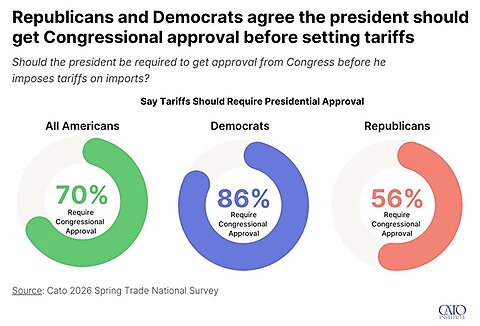
Under the Constitution, Congress has the power to impose tariffs but has delegated some of its authority to the president. A strong majority (70%) of Americans believe the president should be required to get congressional approval before imposing tariffs on imports, according to the survey fielded in March. Only a little less than a third (30%) think this should not be necessary. Notably, majorities of Democrats (86%), Republicans (56%), and independents (68%) agree Congress should approve tariff decisions.
Most Americans (62%) believe that Congress should set US tariff rates on foreign imports, while 38% think the president should get to decide. Partisans disagree. Majorities of Democrats (84%) and independents (67%) say Congress should set tariffs, while conversely a majority of Republicans (60%) say the president should decide.
Most Americans Don’t Want to Work in a Factory
A strong majority (70%) believe America would be better off if more Americans worked in factories than they do today. Yet only 33% would personally want to work in a factory, according to the March survey. These results can be interpreted in multiple ways. First, more people think we need more manufacturing jobs than personally want to work in one. In other words, Americans are much more enthusiastic about other people working in factories than doing it themselves. But also, with about 8% of the workforce currently working in manufacturing, there are more people who want to work in factories than currently do. This suggests there is substantially more potential interest in factory work than the number of people currently doing it.
Are there other jobs not requiring a college degree that people would prefer over factory jobs? The March survey asked whether, if educational requirements and pay were the same, Americans would rather work in a factory or, alternatively, in construction trades, an e‑commerce warehouse, building construction, law enforcement, or trucking, respectively. Americans prefer construction trades and warehouse work over factory jobs but prefer factory jobs over building construction, law enforcement, and trucking.
Most Americans would prefer construction trades like being a plumber, electrician, or HVAC specialist (55%) over being a factory worker (45%), and most would prefer working in an e‑commerce warehouse (53% vs. 47%). However, more would rather work in a factory than work as a truck driver (65% vs. 35%), as a police officer (64% vs. 36%), or as a home builder (60% vs. 40%).
The survey also analyzed how Americans without college degrees thought about working in a factory, which may hold particular appeal. Among those with high school degrees or less, majorities prefer factory work over all the other jobs asked about, including an e‑commerce warehouse (62% vs. 38%), construction trades (55% vs. 45%), truck driving (69% vs. 31%), law enforcement (76% vs. 24%), or building construction (64% vs. 36%).
However, among those who have attended at least some college but did not graduate from college, majorities would prefer working in an e‑commerce warehouse over a factory (55% vs. 45%) or in construction trades (63% vs. 37%). Majorities of those with some college experience would otherwise prefer working in a factory over trucking (59% vs. 41%), law enforcement (63% vs. 37%), or building construction (60% vs. 40%).
Implications
Americans appear to approve of many of the goals President Trump has associated with tariffs more than they like the tariffs themselves. Voters want more manufacturing and factory jobs in the United States and are receptive to the idea of reducing dependence on foreign countries. But that support weakens substantially when Americans are asked to bear the costs personally. Only 38% say they would accept even $100 a year in additional household costs to encourage more domestic manufacturing, and support for tariffs on imported blue jeans falls sharply as the resulting price increase grows.
That tradeoff may help explain why tariffs could become politically consequential in the midterms. Three-fourths of registered voters say tariffs will be important to their vote this November, while 74% believe Trump’s tariffs have increased the prices of things they buy. Majorities also believe tariffs are a tax on Americans (57%) and say Trump’s tariffs have weakened the US economy (53%). At the same time, nearly half of Americans report cutting back on spending over the past six months and many have postponed major purchases.
The results also suggest that the arguments most likely to move public opinion against tariffs are the ones closest to Americans’ everyday economic concerns. Voters are more likely to oppose tariffs if they believe they reduce American jobs, slow innovation, or raise consumer prices than if they lead foreign governments to retaliate or create incentives for special-interest lobbying. In other words, the public appears more responsive to the direct pocketbook consequences of tariffs.
At the same time, Americans are not embracing an entirely unrestricted vision of free trade. Majorities favor free trade as the general rule while allowing exceptions for goods that the government can demonstrate are essential to national security. Voters are also more receptive to tariffs on countries such as Russia and China than on allies such as Canada and England. This suggests that Americans distinguish between tariffs used selectively for strategic or national-security purposes and tariffs imposed broadly as an economic policy.
Finally, there are broad concerns about how tariff decisions are made. Seventy percent (70%) say presidents should be required to obtain congressional approval before imposing tariffs, including majorities of Republicans, Democrats, and independents. Sixty-two percent (62%) go further and say Congress, rather than the president, should set US tariff rates. Taken together, the findings suggest that even as Americans remain open to targeted trade restrictions, most favor greater congressional involvement and limits on unilateral presidential authority over tariffs.
Full TOPLINES and METHODOLOGY for the survey can be found HERE, and CROSSTABS can be found HERE.
Methodology
The Cato Institute, in collaboration with Morning Consult, conducted the Cato 2026 Fall Trade and Populism National Survey from August 13–16, 2026, among 4,150 registered voters. The modeled margin of error for the full sample is ±2 percentage points. Cato, in collaboration with Morning Consult, conducted the Cato 2026 Spring Trade National Survey from March 27–29, 2026, from a sample of 2,002 registered voters. The modeled margin of error for the full sample is ±2 percentage points.
Respondents were drawn from multiple online, opt-in non-probability panels through Morning Consult’s sample exchange, selected using quotas on age, gender, and education. Prior to data collection, secure link authentication and digital fingerprinting were used to prevent duplicate responses. During fielding, attention, speeding, and straightlining checks were applied alongside fraud detection techniques. Post-survey pattern detection algorithms were used to identify and remove suspicious responses. The data were weighted to approximate the composition of registered voters using iterative proportional fitting (raking). Weighting targets included gender by age, gender by children in household, race by educational attainment, educational attainment, race, marital status, home ownership, region, and 2024 presidential vote choice. Demographic weighting targets were drawn from the 2024 Current Population Survey Voting and Registration Supplement. Certain questions were asked of randomly assigned subsamples and carry larger margins of error.