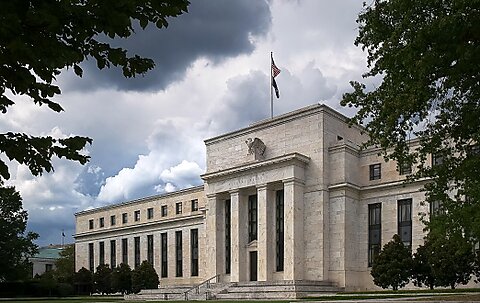















The big news on September 30 was that the Fed’s Inspector General released its report on the Eccles building renovation project. That’s the project that, back in 2025, President Trump and Senator Tim Scott (R‑SC) used to bash Fed Chair Jerome Powell. They criticized him for cost overruns, but it was clearly a political move to pressure Powell because Trump wanted “lower interest rates.”
As my colleagues and I wrote at the time, the Fed’s interest rate target shouldn’t be set based on anyone’s whims or desires, even if that person is the president of the United States. Powell was put in an unprecedented position and was right to stand his ground, regardless of anything else.
Ultimately, Powell decided to remain on the Fed Board of Governors until the criminal investigation was “well and truly over.” And that’s exactly where Powell remains, even though the new chair, Kevin Warsh, is now in charge. But the IG’s report finds “no evidence of administrative misconduct and no grounds to refer anyone for criminal prosecution,” so it could signal the end of Powell’s Fed tenure. (And who wouldn’t want to read his memoirs?)
To anyone who’s been following this political charade, it’s not too surprising that the IG found no grounds for a criminal prosecution. The media have fixated on the Trump v. Powell aspects of this story, but what is being lost in the debate over Fed independence is gross mismanagement by the Fed Board. It’s about much more than Trump v. Powell.
On its own, the report’s executive summary makes a great case that the Fed has a bureaucracy problem.
Between February 2020 and December 2024, the construction portion of the budget more than doubled, from $921 million to $2.018 billion.
The Board didn’t bother to get a project cost estimate until 2026, 3.5 years after construction began and after the Board had awarded more than $2 billion to contractors.
When the IG interviewed the Board, its members “attributed most of the project cost increases…to inflation,” but the increased costs surpassed the price level increase by almost 200 percent. (For those wondering: yes, the Fed is charged with keeping inflation in check. Even if we give the Board a pass on that one, you’d think its members would know inflation wasn’t that high.)
The Board failed to implement any cost controls on this project even though the IG told it to do so in 2021, after similar problems on another renovation project.
So, the Board completely failed to manage the project and just kept paying contractors an extra billion dollars, give or take. And it gets worse.
Within the giant bureaucracy that is the Federal Reserve, the Facility Services section, located in the Board’s Division of Management, was directly responsible for managing the renovation. And since 2019, Winona Varnon had been the director of the Division of Management. In 2025, the Board (presumably with the blessing of Jerome Powell) promoted Varnon to chief operating officer.
That’s right. The person who oversaw a $1 billion cost overrun was promoted to the Fed’s COO. Apparently, no matter how prestigious they are, bureaucracies are terrible at saving money and rewarding merit.
At the very least, this fiasco makes the case for putting the Fed’s non-monetary policy functions on congressional appropriations. Now, I’m not naïve about this switch. I don’t think Congress does a great job controlling spending, and I don’t think most Americans care too much about anything the Fed is building.
But as it stands, the Fed can spend whatever it wants, right into oblivion, and there’s nothing Congress can do about it even if members’ constituents get miffed. That’s an improper way to structure a federal agency in a representative government, and Congress’s power of the purse is a primary oversight mechanism for federal agencies.
Congress can make this switch, of course, without having any impact at all on the Fed’s monetary policy operations. Those are self-funding, and they can stay that way. But there is simply no good reason to leave the Fed structured as it is now, and the IG’s report proves it.