





On August 14, the 91st anniversary of the Social Security Act, I’ll debate Wendell Primus of the Brookings Institution about how to address Social Security’s looming insolvency. We agree that Congress should act to avert automatic and indiscriminate benefit cuts and that Social Security should be reformed without exacerbating the federal budget crisis.
Where we disagree is more fundamental: What should Social Security be?
I believe the program should be changed to provide a fiscally sustainable, predictable retirement benefit based on years worked, while enabling Americans to build wealth through private savings by not increasing their tax burden.
Wendell and his co-authors, Tara Watson and Jack A. Smalligan, propose increasing Social Security’s spending and preserving it as a wage-replacement program through a combination of benefit changes and higher taxes.
The debate is organized by Concord Action and will be held online this Friday, August 14, at 11:00 a.m. ET. To receive the Zoom link, register below.
Reimagining Social Security
Social Security was created for a very different America. Retirement as a lifestyle choice had not been invented yet. Life expectancy was much lower than it is today. And Americans had a lot more children than they do now.
The retirement landscape also fundamentally changed. Most full-time private-sector workers (81 percent) have access to employer-sponsored retirement plans, and Americans have unprecedented opportunities to accumulate retirement wealth outside Social Security.
Rather than asking younger workers to finance an increasingly expensive and unnecessary wage-replacement system through higher taxes, Congress should gradually transition Social Security toward a flat-benefit structure that provides predictable, reliable, and fiscally sustainable benefits while allowing individuals to build additional retirement wealth through private savings.
Critics argue that a flatter benefit would weaken political support for Social Security because workers expect benefits proportional to their taxes. But that relationship has never been as direct as commonly assumed. Early beneficiaries received returns far exceeding their contributions, the benefit formula is already highly progressive, and spousal and survivor benefits further disconnect benefits received from taxes paid.
Moreover, Americans appear more open to fundamental change than many policymakers assume. Our recent survey found that nearly half of respondents (48 percent) support replacing the current earnings-based benefit formula with a flat benefit that raises benefits for lower earners while reducing them for higher earners, with especially strong support among younger Americans.
The Brookings Plan Has Some Worthwhile Benefit Changes
The Brookings proposal contains some worthwhile changes. Raising the retirement age reflects longer life expectancy, and eliminating outdated spousal benefits would better reflect today’s workforce.
Retirement age increases should apply across the board, as low reported earnings are not necessarily indicative of someone’s life expectancy or of where they fall in the wealth distribution. The disability program also provides a pathway to earlier benefit receipt for workers who are truly unable to continue working, with easier eligibility criteria for applicants aged 50 and older.

To ensure that Social Security continues to adjust automatically to future demographic changes, Congress should also consider indexing the retirement age to gains in life expectancy. This is a policy that about a quarter of the Organisation for Economic Co-operation and Development (OECD) countries have already adopted.
The Brookings plan would also redirect revenues from benefit taxation that currently flow to Medicare into Social Security. Primus and his colleagues make a correct point: “Taxation of Social Security benefits is more closely related to the cash benefits paid out from the Social Security trust funds than to the Medicare HI Trust Fund. As such, proceeds from the taxation of benefits should contribute to funding the Social Security program.” This change would worsen Medicare Part A’s finances, which should be addressed as part of broader Medicare reform. For Medicare reform ideas, see here and here.
The proposal would also tax all higher earners’ Social Security benefits. Congress should go further. Between existing income thresholds, the standard senior deduction, and the temporary senior deduction enacted in last year’s reconciliation bill, less than half of seniors pay any income tax on their benefits. Policymakers should treat Social Security benefits as other income and remove income thresholds that exempt many of the current beneficiaries.
The Brookings Plan Would Increase Social Security Spending
But these marginal benefit changes are overwhelmed by a broader objective: fueling an outdated wage-replacement system with ever higher taxes.
The result is a plan that increases Social Security’s overall spending by roughly 12 percent relative to current law, while relying heavily on tax increases to finance those additional costs and close the trust fund financing gap.
The plan would raise the payroll tax cap, currently $184,500, to cover 90 percent of earnings. The authors have since acknowledged that the percentage of covered earnings would need to climb higher as Social Security’s outlook has worsened. This policy would raise taxes on America’s most highly skilled professionals, including surgeons, radiologists, psychiatrists, and cardiologists, whose services Americans increasingly struggle to access. The original plan would also increase the payroll tax rate from 12.4 percent to 12.6 percent, though the authors likewise recognize that an even larger increase would likely be required by now.
This goes to show that without tackling relentless benefit increases, a plan that relies primarily on higher taxes will inevitably fall short without addressing the primary driver of the growing funding gap: rising benefit spending.
The Real Question Is How Much to Spend and on Whom
Primus et al. argue that they wouldn’t fully eliminate the payroll tax cap because “if the taxable maximum is eliminated, high earners would get huge benefits because more of their earnings would be included in the Social Security benefit formula […] It is […] poor safety net policy to divert more Social Security funds to high earners.” I agree.
But that raises a more fundamental question: why is Social Security already paying such large benefits to affluent retirees in the first place?
The program directs substantial resources to middle- and upper-income households because benefits are tied to lifetime earnings. Census Bureau research shows that beneficiaries in the top 20 percent of the income distribution received roughly the same total benefits as the bottom 40 percent combined (see chart below). Some retirees receive annual benefits exceeding $60,000, with dual-earning high-income couples able to claim twice that amount.
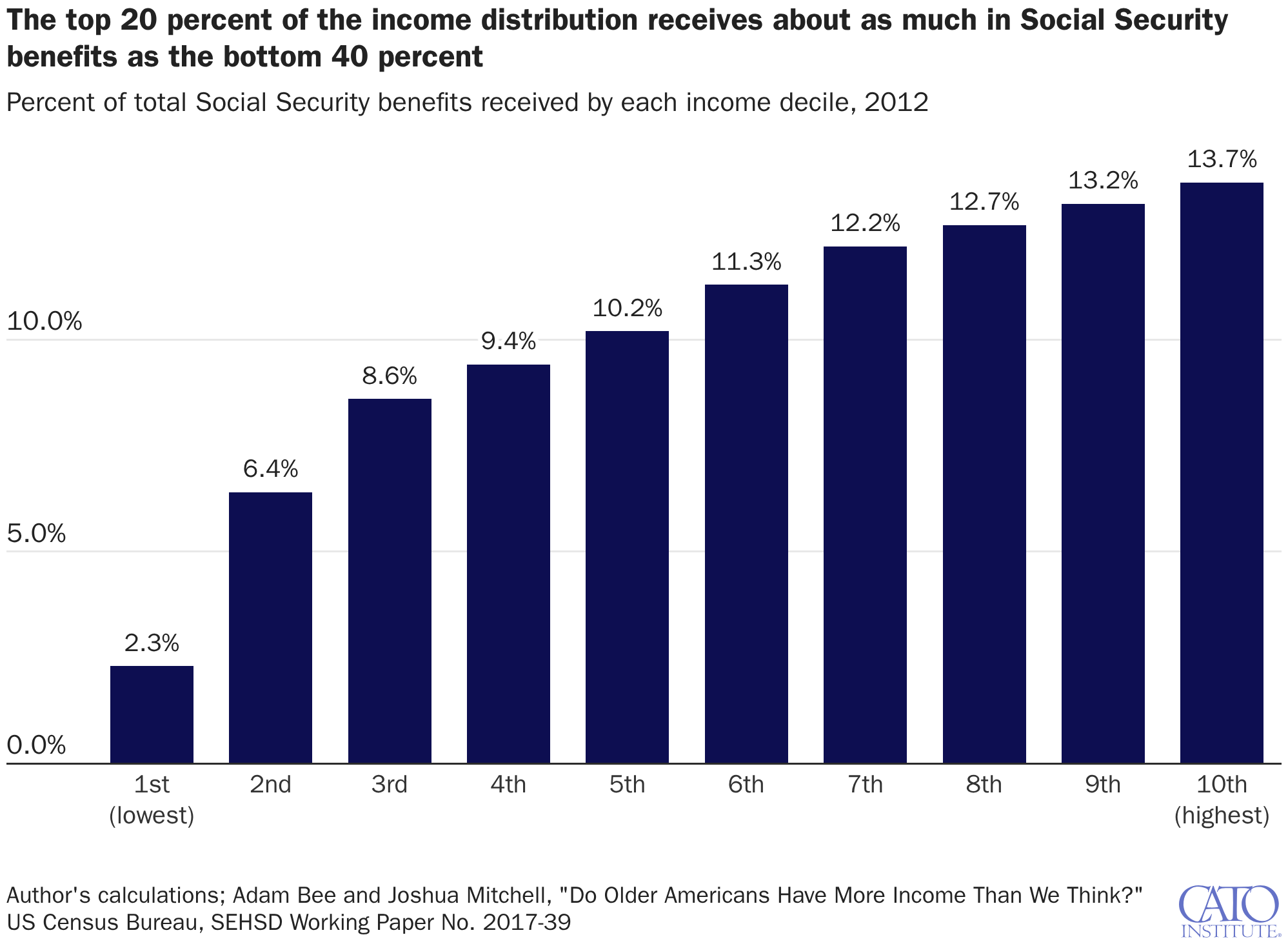
Because benefits are based on taxes paid by younger workers, rather than retirees’ savings, Social Security should look more like a targeted retirement safety net, rather than redistributing the most income to older Americans with the highest lifetime earnings.
The current system practices Robin-Hood redistribution in reverse: taking from the poor to give to the rich.
What Should Social Security Be?
Americans face a choice. We can preserve an increasingly expensive wage-replacement program by continually raising taxes on workers. Or we can modernize Social Security into a sustainable guarantee against poverty while allowing workers to build greater retirement wealth through private saving and investment.
One lets Washington control more of workers’ earnings. The other empowers Americans to own their future.
The author thanks Ivane Nachkebia for his contributions in preparing this piece.