


Last week, the Commerce Department announced a $500 million CHIPS Research and Development award to SandboxAQ, an artificial intelligence and quantum-related software company spun out of Alphabet. In return, Commerce will receive a “minority, non-controlling equity stake.” According to Reuters, the government will also receive royalty payments if SandboxAQ successfully develops materials that are licensed to industrial partners.
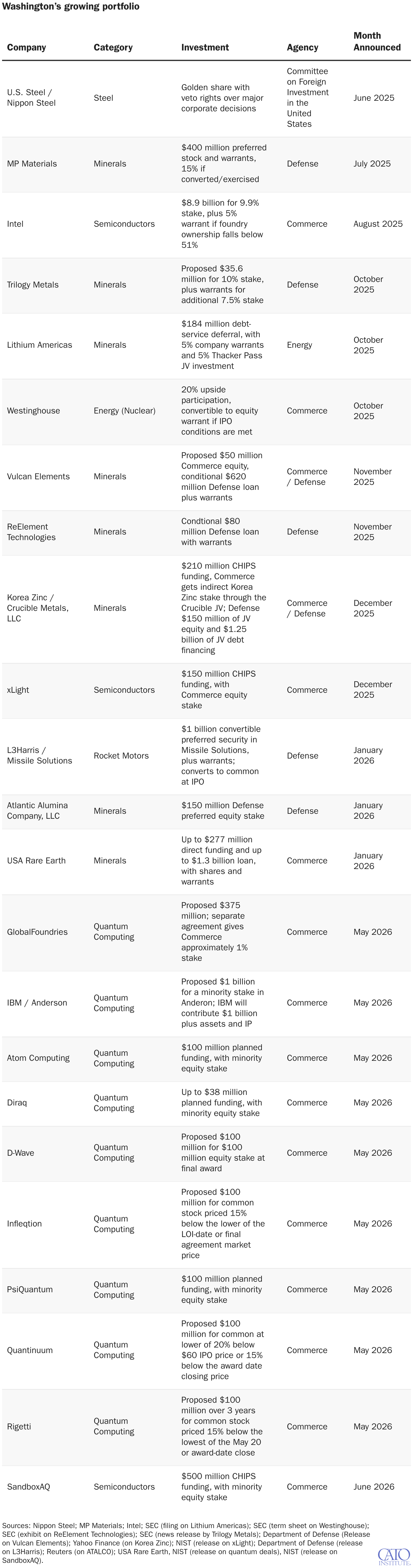
By my count, that’s the administration’s 23rd equity deal, including the “golden share” in US Steel (see table below).
Commerce says the money will support the company’s work on four semiconductor-related materials problems: alternatives to PFAS chemicals, catalysts used in chip manufacturing, rare-earth-free magnets, and battery chemistries for backup power at semiconductor facilities. The public justification is the usual industrial policy script: resilient supply chains, Chinese dominance of critical minerals, semiconductor dependence on specialized materials, and therefore, Washington must intervene.
There’s no doubt that SandboxAQ’s cutting-edge endeavors could yield broader economic benefits, but that doesn’t mean the federal government should invest $500 million in one private company, take an ownership stake, and negotiate for a cut of future commercial revenue.
This is not a struggling upstart with no access to capital. Reuters reports that the company was valued at $5.75 billion in 2025 and has raised more than $1 billion in funding. Its backers include Nvidia, Google, Eric Schmidt, T. Rowe Price, and others. Recent financial statements show that Nvidia and Alphabet, Google’s parent company, together had more than $175 billion in cash and other readily investable resources available.
The deeper issue isn’t whether the government might someday profit from the deal. As I’ve argued before, the federal government isn’t a mutual fund. A future gain won’t meaningfully improve the federal government’s woeful fiscal position, and a loss would be absorbed by taxpayers. Either way, government ownership creates favoritism, conflicts of interest, and invites political meddling and corruption.
The royalty provision makes the deal even more objectionable.
Commerce’s legal theory appears to rest on broad “other transaction” authority. The CHIPS Act allows Commerce to enter into contracts, grants, cooperative agreements, and “other transactions” on terms the secretary considers appropriate and to require payments to the department as a condition of support. But Congress didn’t clearly tell Commerce it could become a shareholder or royalty collector in private technology companies.
That language comes from Commerce’s own funding notice. Under the more familiar Bayh-Dole model, companies generally retain ownership of federally funded inventions. At the same time, the government receives a paid-up license, allowing it to use the invention for government purposes without paying additional royalties. That’s quite different from Commerce taking equity and grabbing a cut of future commercial licensing revenue.
The royalties would be better left in the private sector. SandboxAQ could retain them to finance its own research, operations, or expansion, or private backers could receive them as compensation for risking their own capital. In addition, competitors should be able to pursue alternative technologies without being forced to compete against a government-sponsored rival.
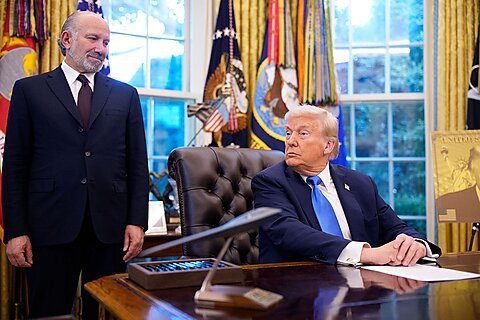
Instead, the administration is inserting the federal government into another company’s boardroom—not because it’s primarily concerned about supply chains or taxpayer “upside,” but because Trump wanted a government investment portfolio he could control, with Commerce Secretary Howard Lutnick dutifully serving as fund manager and dealmaker.