



Every few weeks, fresh speculation emerges about when the Federal Reserve will change its interest rate target, followed by confident claims that this decision will drastically alter the mortgage, auto, or credit card rates that weigh on American households. The assumption beneath the coverage is that the Fed sets the cost of borrowing, so its next move matters more than anything else. People don’t want to hear that the Fed matters less than “everyone” thinks, but at the very least, the past seven months are enough to question exactly how much the Fed controls rates.
The Fed has held its rate target steady since its December cut. But as this table shows, nearly every rate Americans actually borrow at has climbed over the same stretch.
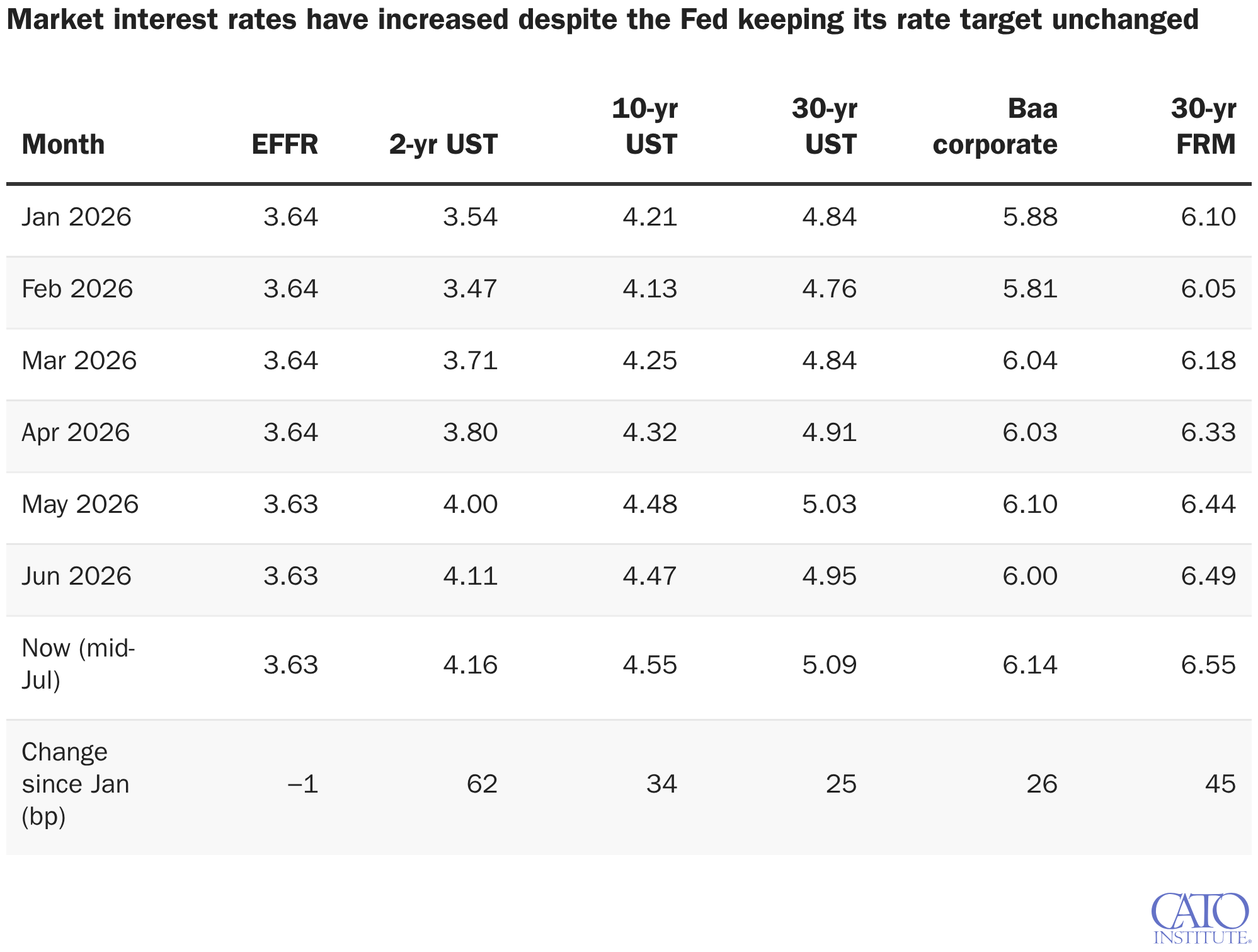
The effective federal funds rate, the overnight rate the Fed tries to steer, barely moved, ending a single basis point lower. But all the market rates—the ones that are supposedly tied to what the Fed does with its FFR target—rose. The 2‑year Treasury rose by 62 basis points, the 10-year by 34, the 30-year by 25, Moody’s Baa corporate yield by 26, and the 30-year mortgage by 45. The Fed did nothing, and the cost of credit went up anyway.
Notice which rate moved the most. The 2‑year Treasury, the maturity most sensitive to the expected path of Fed policy, rose the furthest while the Fed sat still. Markets spent these months repricing macroeconomic events such as sticky core inflation, a volatile energy market driven by the conflict in the Middle East, and global trade disrupted by tariffs, among others. None of that required a policy change to show up in borrowing costs because markets, not the FOMC, set prices.
This pattern is not new, as I documented in a previous blog post. Since the Fed rebuilt its operating framework around a floor system after 2008, the federal funds rate has steadily lost its connection to other rates. Same-month correlations that once ran near 100 percent have fallen to 70 percent for the mortgage rate, 58 percent for the Baa yield, and 71 percent for the 10-year. The timing is off, too. Research shows that market rates tend to move first, with the funds rate following. On the evidence, the Fed takes its cue from markets more than the reverse, consistent with a broader body of Cato research finding that it matters less than commonly assumed.
The reason lies in what actually determines a borrowing rate. Any market rate is built from the expected average path of that rate over its term, and it includes premiums for various risks. It could include, for instance, a term premium that compensates the investor for tying up money for long periods, as well as premiums for credit risk, inflation expectations, a government’s fiscal outlook, and the economy’s expected growth.
That is why the 2‑year Treasury yield can jump 62 basis points without the Fed changing its stance. Its level reflects the market’s reading of where policy is headed, and that reading responds to data the Fed does not control and cannot perfectly forecast. The Fed’s target is a signal about today; the borrowing rates households and firms face are a forecast about the years ahead.
Treating the Fed as the arbiter of every borrowing cost invites two mistakes. It leads the public to demand that the Fed steer rates it does not set, which is the very pressure that pushes the central bank toward overreach. And it sets households up for disappointment when a long-awaited cut arrives, and the mortgage rate does not budge, because that rate, responding in advance to economic forces, has already priced in the Fed’s cut. Accurately priced borrowing rates will come from credible disinflation and disciplined budgets and from a Fed content to follow the economy rather than pretend it leads it.