

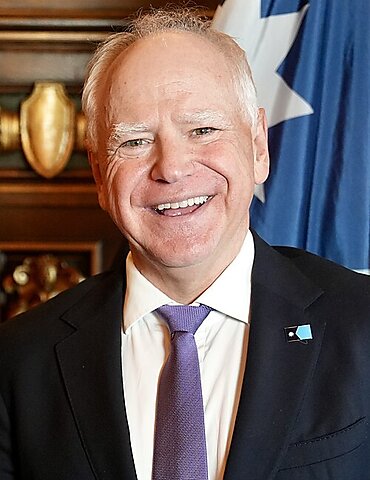

In a stunning and highly critical ruling, US District Judge Patrick Schiltz quashed a series of Justice Department grand jury subpoenas aimed at Minnesota Governor Tim Walz and several of his top allies. Judge Schiltz didn’t hold back, calling the subpoenas an abusive, retaliatory tactic meant to punish state officials for refusing to help facilitate President Trump’s immigration crackdown. Judge Patrick Schiltz stated there was “no doubt” that the subpoenas were issued with the explicit intent to damage Walz, framing the move as part of a larger, disturbing pattern by the Trump administration to weaponize the criminal justice system against its political adversaries.
The 29-page ruling pulled no punches regarding the ethics of using federal law enforcement as a political tool. Judge Schiltz wrote that initiating a criminal investigation to harass political opponents or to coerce them into taking official action—particularly official action that the federal government cannot directly require those political opponents to take—is a blatantly unlawful and unethical use of the grand-jury process.
Schiltz, a George W. Bush appointee, pointed directly to President Trump’s public rhetoric. He noted that the president’s repeated attacks and explicit promises of “retribution” against Walz and other Minnesota Democrats established beyond reasonable dispute what was happening. According to the ruling, the subpoenas, which were issued during the height of ICE’s aggressive “Operation Metro Surge,” were clearly part of a broader, coordinated campaign to force Minnesota leaders into falling in line with federal immigration enforcement.
Briefly shifting from the political theater, Judge Schiltz anchored his decision firmly in constitutional law. He reminded the Justice Department that the US Constitution strictly bars the federal government from compelling states to enforce federal laws, a key legal principle known as the anti-commandeering doctrine. Furthermore, Schiltz noted that this wasn’t an isolated incident. He explicitly linked the Minnesota subpoenas to the administration’s well-established history of using criminal investigations to retaliate against and pressure opponents, highlighting a recent case involving Federal Reserve Chair Jay Powell, in which US District Judge Jeb Boasberg quashed the subpoenas on the exact same grounds of political retaliation.
The weaponization and abuse of the grand jury process highlighted by Judge Schiltz mirrors explosive legal disasters that have unfolded across the country. In the Northern District of Illinois, federal prosecutors and the US Attorney’s office, led by US Attorney Andrew S. Boutros, have come under intense scrutiny following a series of high-profile cases that completely imploded due to prosecutorial overreach.
The most public of these is the spectacular collapse of the case against the “Broadview Six,” which stemmed from a protest against the administration’s Chicago-based mass deportation campaign known as “Operation Midway Blitz.” Federal prosecutors made three separate attempts to secure an indictment against the anti-ICE street protesters. However, the case dissolved when District Judge April Perry forced the government to hand over unredacted transcripts of the secret grand jury proceedings.

The unmasked records revealed a pattern of shocking manipulation. Prosecutors had heavily redacted over 215 lines of transcripts to hide misconduct from the judge. The lead veteran prosecutor, Sheri Mecklenburg, had engaged in inappropriate private conversations with grand jurors and utilized impermissible prosecutorial vouching. Most egregiously, skeptical grand jurors who questioned the strength of the government’s case were unlawfully dismissed from the panel entirely.
Facing systemic exposure, Attorney Boutros was forced to make an extraordinary personal appearance in court to apologize and drop all charges with prejudice. The fallout has been swift and severe. Mecklenburg lost her detail with the Senate Judiciary Committee, and Illinois Senators Dick Durbin—the Ranking Democrat on the Senate Judiciary Committee—and Tammy Duckworth have jointly called for Boutros’s resignation, describing his tenure as “riddled with chaos, deep internal dysfunction, and alleged misconduct.” Defense attorneys and congressional leaders, including Congressman Jamie Raskin (D‑MD)—the Ranking Democrat on the House Judiciary Committee—are now demanding an investigation.
The Broadview Six scandal is not a localized fluke but a symptom of an emerging, multi-front pattern of federal overreach and pervasive prosecutorial misconduct. In quick succession, the Chicago-based Attorney’s office was forced into another retreat, dismissing charges against three armed robbery suspects—two of whom had actually been shot earlier that month during a botched undercover ATF weapons and trafficking operation. Close on the heels of that embarrassment came the collapse of the Loretto Hospital COVID-19 fraud cases, in which federal overreach again collided with judicial skepticism, forcing prosecutors to abandon heavily publicized indictments as their evidentiary foundations eroded under scrutiny. These examples could compromise future cases, exposing a pattern of behavior by misconduct-prone prosecutors who leave a tainted legacy in their wake.
What we’re witnessing is a dangerous ethos of winning at all costs. Whether the Trump administration is targeting a Democratic jurisdiction’s political leadership to force compliance with federal immigration prerogatives or taking extraordinary, rule-breaking measures to secure indictments against local activists and business owners, the pattern is identical: the ends are used to justify the means. Fortunately, the courts are increasingly stepping in to act as a constitutional bulwark, protecting citizens and local institutions from a tyrannical government.
This judicial pushback was put on vivid display in Minnesota. By throwing out all six subpoenas in one fell swoop, Judge Schiltz delivered a massive legal victory to Minnesota officials. More importantly, the ruling drew a sharp, protective line around the structural independence of state and local governments, sending a clear message to the Justice Department that the grand jury system is an instrument of justice, not a weapon for the regime to use at its will.