

President Donald Trump issued an executive order to stop the creation or development of a central bank digital currency (CBDC). Yet rumors have begun to swirl that the Federal Reserve is ignoring this order and actively working on a wholesale CBDC.
The rumors began when former Commodity Futures Trading Commission Chair Timothy Massad said, “We don’t have a central bank president who is going to get out there and speak about wholesale or retail CBDC, but that does not mean that we are not looking at how to create one.” Now those rumors have been confirmed. The Bank for International Settlements (BIS) revealed that the Federal Reserve Bank of New York (New York Fed) is still an active participant in Project Agorá.
Project Agorá Explained
Project Agorá centers on using tokenization for cross-border payments. For the unfamiliar, tokenization simply means that they are creating representations of money on a blockchain or shared ledger. It’s like creating a certificate of ownership so you don’t have to carry around the asset in question. However, because these are digital representations, they can also be programmed through smart contracts.
In Project Agorá, the assets being tokenized are central bank reserves and commercial bank deposits. And it’s the tokenization of central bank reserves that has our attention today.
A CBDC by Any Other Name
The Bank for International Settlements has been careful to avoid the term “CBDC” when describing Project Agorá. However, at the same time, it doesn’t deny that Project Agorá is a CBDC project. In a call for participation, the Bank for International Settlements included a frequently asked questions section. Among the questions considered, it was asked whether CBDCs are being used in Project Agorá. The suggestion was neither confirmed nor denied:
Agorá will experiment with integrating tokenised wholesale central bank money and tokenised commercial bank money. Tokenised wholesale central bank money is a version of the reserves that commercial banks currently hold in accounts with the central bank. The general public does not hold or use this money for transactions.
Yet, Project Agorá effectively uses a wholesale CBDC.
Unlike a retail CBDC designed for the general public, a wholesale CBDC is typically defined as a central bank digital liability restricted to financial institutions for interbank settlement. With that in mind, the difference between wholesale CBDCs and tokenized reserves is razor-thin (Table 1).
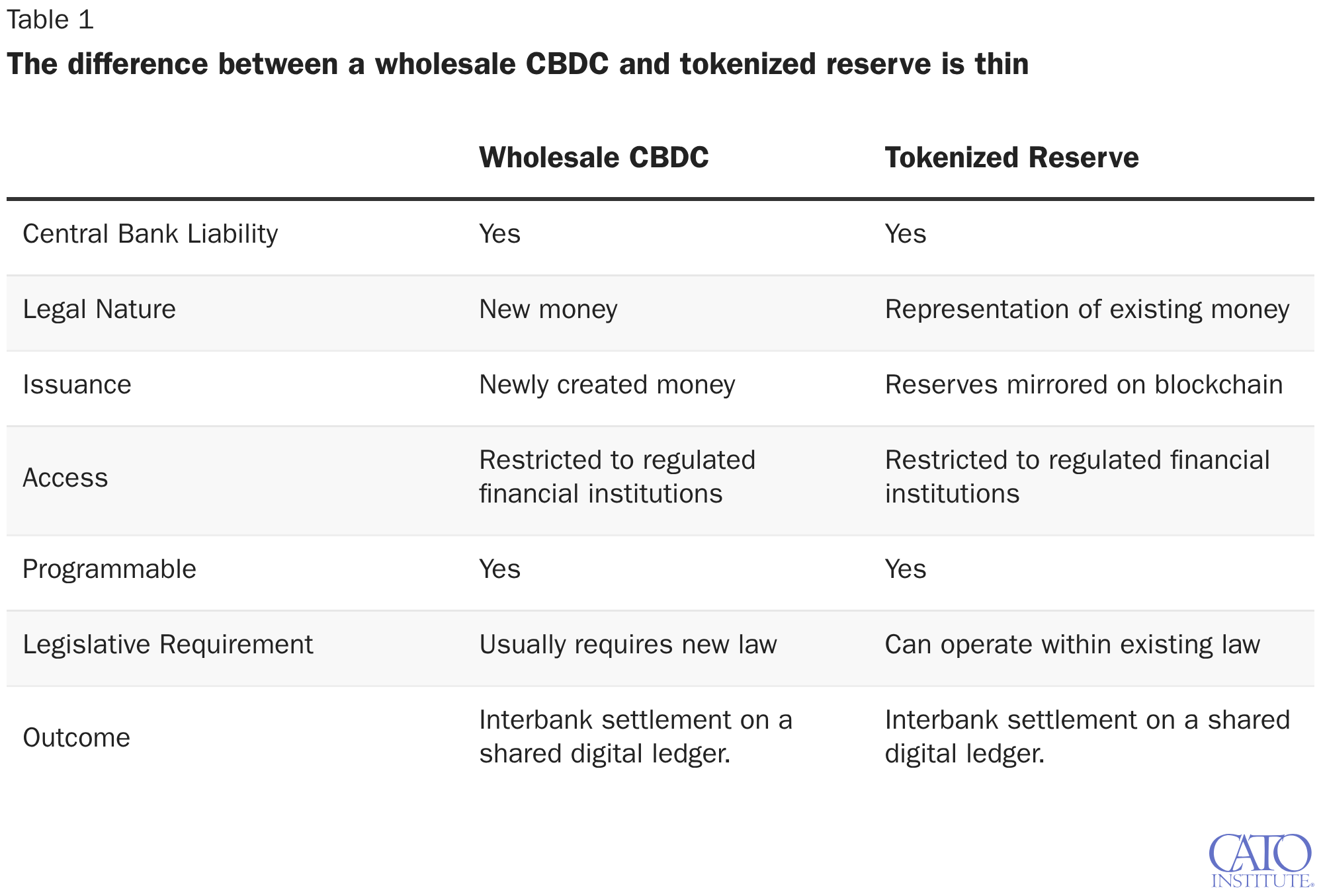
If a wholesale CBDC were ever actually deployed, it would almost certainly look functionally identical to what Project Agorá built. The legal distinction seems to largely be a political and institutional workaround. Central banks have seen the pushback CBDCs have received, so now they are calling “tokenized reserves” a “technical upgrade” to sidestep the fight entirely.
Conclusion
Because the project operates in a grey area, the Federal Reserve should be questioned. Why exactly does it view participation in this project as being compliant under the executive order? Is it that the tokenization element creates a loophole? Is it that the regional Federal Reserve isn’t required to comply with the executive order? Or is something else at play? Both Congress and the president should get answers here.