




Norbert J. Michel and Jerome Famularo

The Council of Economic Advisers’ 2026 Economic Report of the President tells a familiar story: The American dream of homeownership is slipping away. Chapter 6, in particular, leans heavily on a series of charts meant to show that housing has become less affordable, less attainable, and more distorted by regulation.
While it is true that regulation adds unnecessary costs and distortions to the housing market, much of this “unaffordability” narrative depends on how the data are presented. Change the framing, even slightly, and the story starts to look very different.
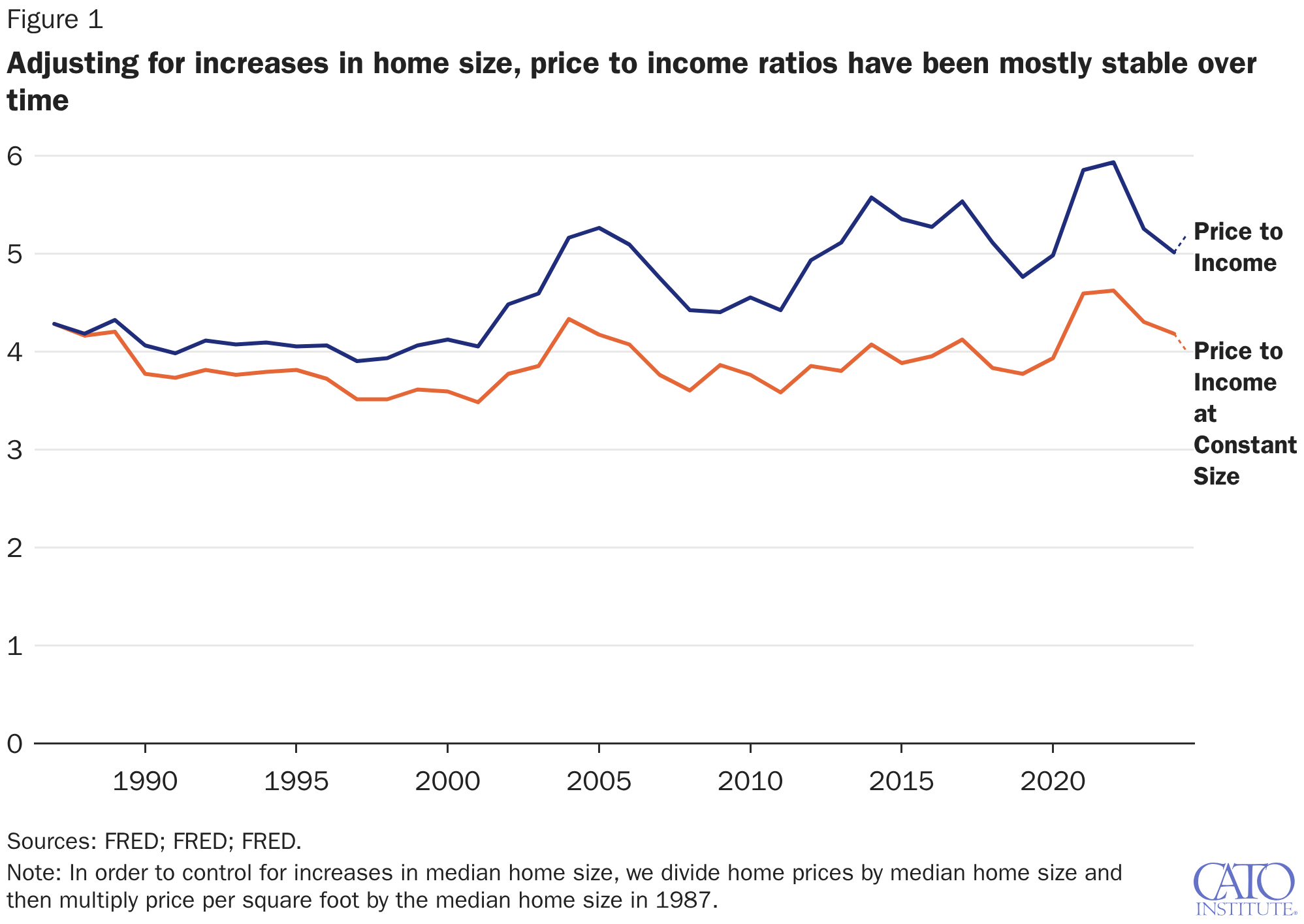
Take the report’s central claim that housing has become dramatically less affordable because home prices have outpaced income. That conclusion rests on a simple comparison of real house prices to real median income. Among other problems, this comparison ignores the fact that homes being built in recent years are not the same as those built in years past: They have more standard features and, most notably, are larger in size on average.
To ignore these changes is to ignore part of the reason why housing is more expensive. If people are spending more on housing because they’re buying more and/or better housing, they’re consuming more. And that’s not the same thing as being priced out. Nonetheless the report treats the entire increase in housing costs as a burden rather than as higher consumption (Figure 1).
That distinction matters for policy. If rising costs reflect preferences, not constraints, then the “problem” isn’t really much of a problem.
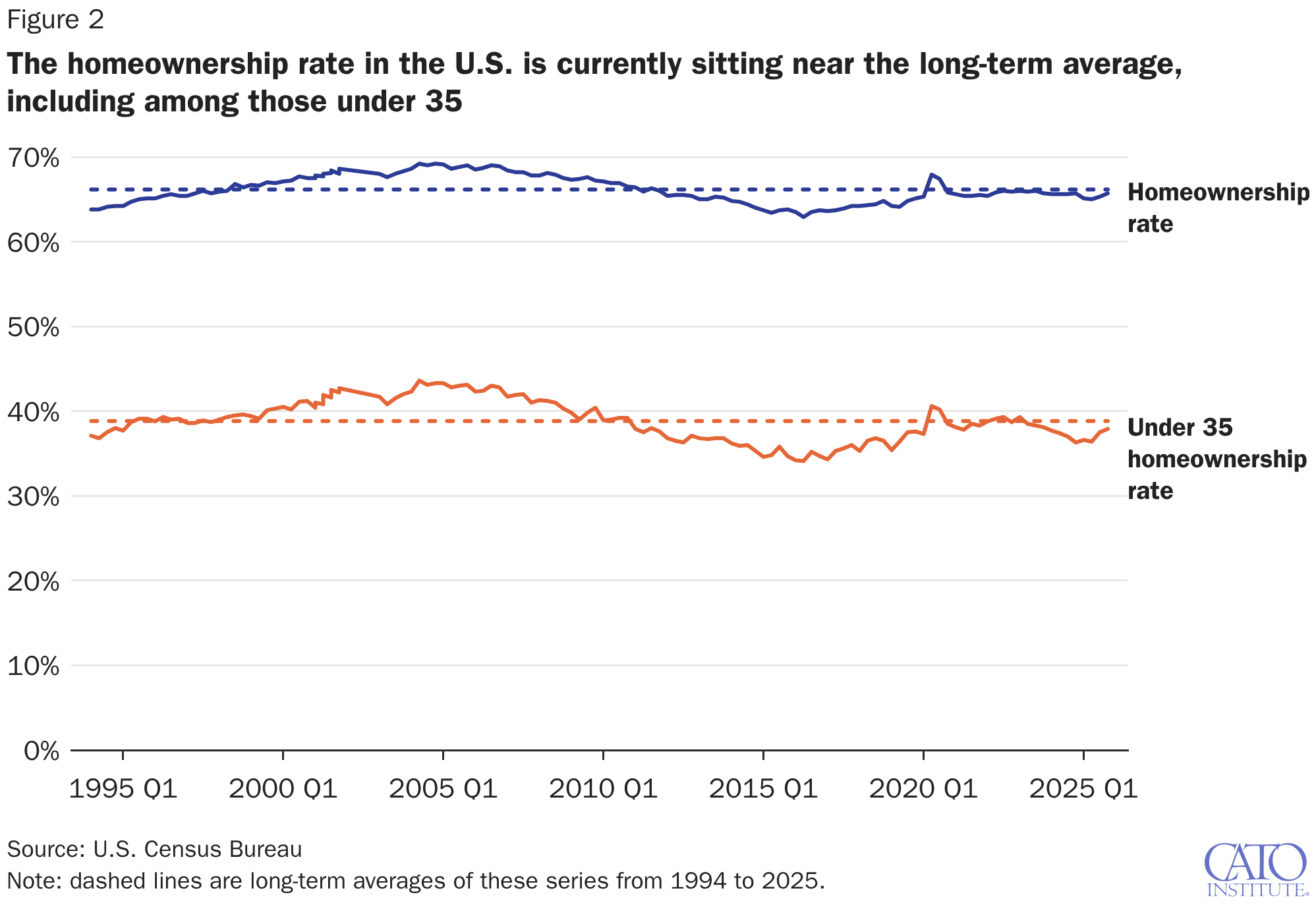
A similar framing issue shows up in the report’s treatment of homeownership rates. By comparing 2000 to 2023, the report suggests a worrying decline, especially for younger Americans. But 2000 was not just any year—it had higher than average homeownership rates relative to other years.
Zoom out, and the trend looks much less alarming. For instance, the homeownership rate for Americans under age 35 is roughly in line with where it was throughout much of the 1990s. The overall rate shows a similar pattern. You can make the numbers look bad by picking convenient endpoints, but that doesn’t tell you much about the underlying trend (Figure 2).
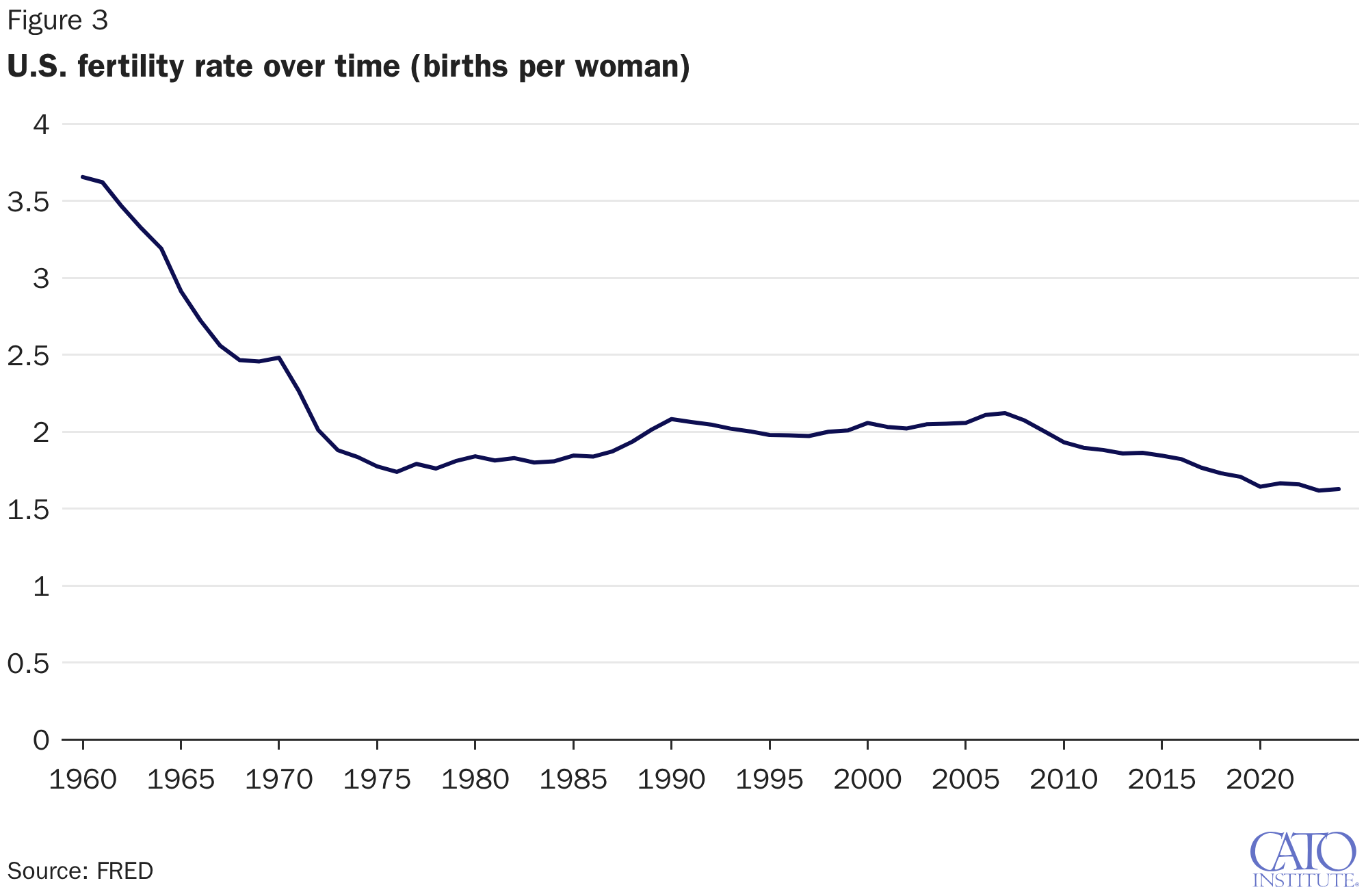
The report’s discussion of fertility follows the same script. It highlights the decline in birth rates after the financial crisis, implying a connection to housing affordability. But fertility in the early 2000s was higher than in much of the 1970s and 1980s. (It actually dropped sharply in the 1960s and only started climbing again in the 1980s.) Without that context, the postcrisis drop looks more unusual—and more policy-relevant—than it really is (Figure 3).
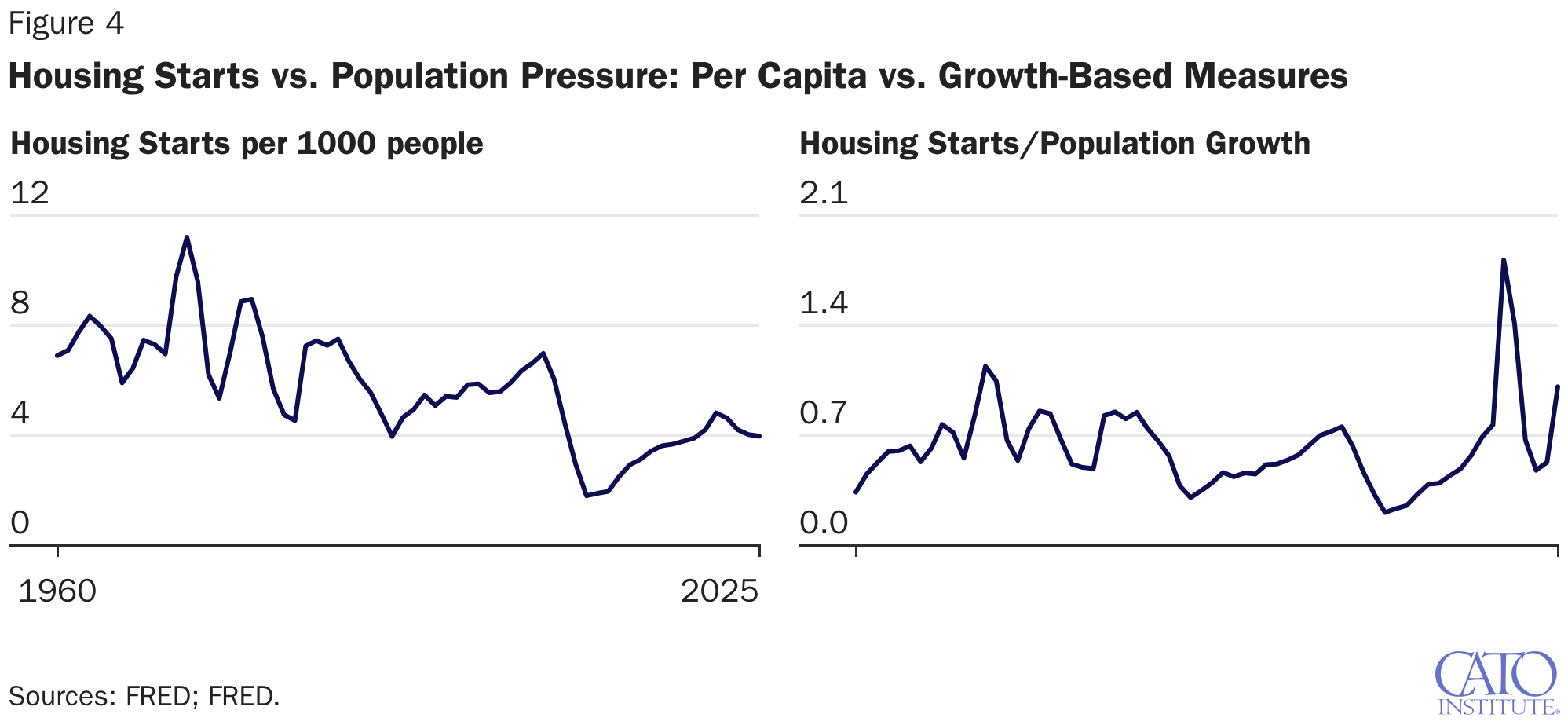
The report also examines housing starts per million people, a metric that appears to be a reasonable way to measure construction activity. However, people don’t consume housing “starts.” They consume housing units. Thus, the measure fails to compare the total number of people to the total number of available housing units, a major shortcoming.
A more meaningful comparison would look at net additions to housing relative to population growth (net additions of people). Make that adjustment, and the mid-2000s slowdown in construction doesn’t look nearly as severe as the report suggests. (Figure 4 provides a side-by-side comparison of the two metrics. Dividing by population instead of growth clearly makes the situation look worse than it is.)
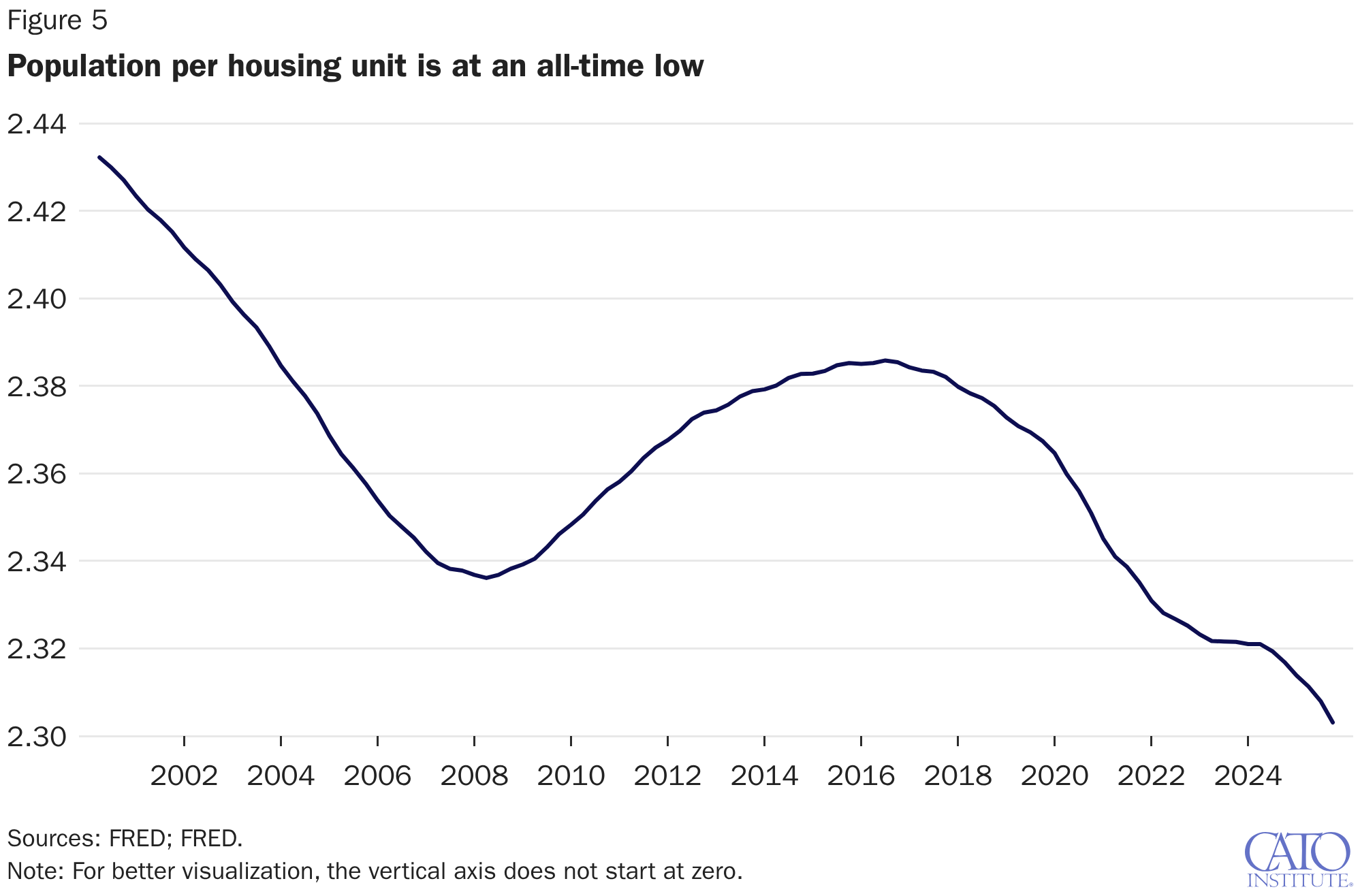
Additionally, the number of people living in the typical home (i.e., people per unit) in the US has gone down over time. People increasingly want to live alone and have smaller families, which creates pressure for more individual units to be shared among fewer people. But this preference comes with a cost too (Figure 5).
The report’s focus on single-family housing growth suffers from similar problems. It highlights certain periods to show a slowdown but ignores other periods. It also ignores the growing role of multifamily and attached housing. Once again, the choice of what to include—and what to leave out—does most of the work.
Where the report leans most heavily on analysis rather than simple comparisons, the problems don’t go away. They just become more technical.
For instance, several figures attempt to estimate the cost of regulation by comparing actual housing outcomes to an “unregulated” counterfactual. These estimates borrow from the same framework used in the housing shortage literature. And like those estimates, they depend heavily on assumptions that are hard to verify. (For a discussion of the housing shortage narrative, see this paper.)
More broadly, federal policymakers are overly concerned with so-called housing shortages.
In reality, as communities grow and people earn higher incomes, higher demand for housing can put upward pressure on prices. (Even if that demand comes mainly from “rich” people, it can put upward pressure on average housing prices.) Viewing this kind of price increase as a shortage or market failure is counterproductive. Over time, this demand tends to be met, keeping up with the needs of a growing population.
Either way, the supply of housing is not the sole determinant of house prices. Ignoring this lesson and implementing policies that merely focus on boosting supply (especially through federal subsidies, grants, tax credits, etc.) can lead to depressed home values and oversupply, just as implementing demand-boosting policies can distort markets. The best thing for the federal government to do is to stop interfering with the market.
Of course, certain policies make it more difficult and expensive for builders to meet new demand, and state and local officials should implement the best policies for their local growth conditions. To be clear, supply constraints and regulations matter. Zoning rules, permitting delays, and other restrictions make housing more costly. However, if rising housing costs partly reflect larger homes and higher incomes, then policies aimed at forcing down prices (such as mass deportations and bans on institutional investors) could have unintended consequences.
Sure enough, recent research from the San Francisco Fed suggests that faster income growth, not supply constraints, explains much of the differences in house price trajectories across metro areas. This finding makes sense because, for the past few decades, Americans have been earning higher incomes. All else equal, this fact should help explain higher housing prices.
Ultimately, policymakers should be wary of solutions built on a misleading diagnosis. In housing, as in economics more broadly, how you measure the problem often determines how poorly you solve it.