




The federal government is so large that many of its policies work at cross-purposes. The government exhorts us to eat healthy, but subsidizes junk food in the food stamp program. It urges moms to breastfeed but subsidizes baby formula. It condemns tobacco use but subsidizes tobacco farming.
Subsidizes tobacco? Yes, it’s crazy, but tobacco farmers still get subsidies from the US Department of Agriculture’s crop insurance program, which is the largest farm subsidy program.
The program is not really “insurance” but rather a way for politicians to smuggle $15 billion a year from taxpayer pockets into the pockets of wealthy farmers. The government pays about 60 percent of farmer premiums and about $4 billion a year in administrative costs and underwriting gains to the 12 private insurance companies that administer the program.
EWG.org has compiled federal data on tobacco crop insurance. From 2015 to 2024, the government paid an average of $60 million a year in premium subsidies to farmers, which means that farmers themselves paid about $40 million in premiums. In return, farmers received annual average insurance payouts of about $190 million. Thus, on net, tobacco farmers are profiting about $150 million a year from the federal program.
The tobacco share of the overall crop insurance program is small, but it’s a scandal that tobacco is subsidized at all. Also, tobacco subsidies have attracted an inordinate amount of fraud over the years.
Tobacco Subsidy Fraud
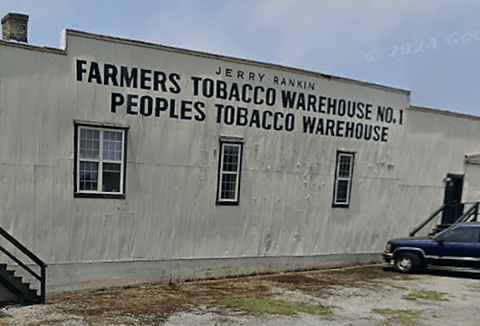
We discussed one tobacco subsidy scandal last week. Seven farmers in Kentucky and the manager of Farmers Tobacco Warehouse in Danville were convicted of fraud in 2025. They stole tens of millions of dollars of taxpayer money by faking production, sales, and loss data. The fraud continued for years before the government noticed.
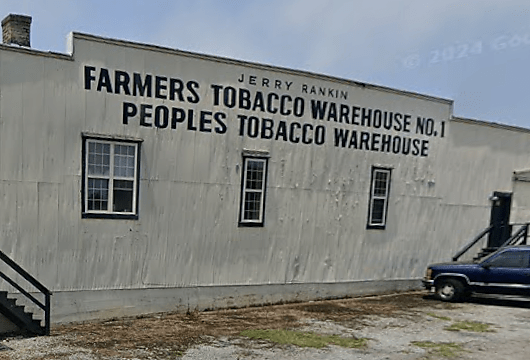
An even larger Kentucky tobacco scandal erupted a few years earlier. The crime swirled around Clay’s Tobacco Warehouse in Mount Sterling. Farmers, insurance agents, insurance adjusters, and warehouse employees teamed up to steal more than $40 million from federal taxpayers.
The largest theft was perpetrated by insurance agent Michael McNew, who was convicted in 2020. In return for kickbacks, McNew worked with tobacco farmers to falsify their claims regarding crop damage, acreage, and ownership. He participated in stealing $23 million from taxpayers.
Roger Wilson, owner of Clay’s Tobacco Warehouse, played a key role. He was convicted in 2021 of aiding the theft of $9 million. Over a five-year period, he worked with farmers to produce fake sales receipts and other documents. Warehouse employee and crop insurance agent Debra Muse helped with the fake paperwork and was also convicted.
All in all, more than a dozen tobacco farmers pleaded guilty to criminal charges, and another 17 people paid civil penalties in these Kentucky rip-offs. In some cases, the theft was a family affair. Among those convicted were father-and-sons tobacco farmers Jimmy Price, Bradley Price, and Brandon Price, who stole hundreds of thousands of dollars with the help of Clay’s Tobacco Warehouse.
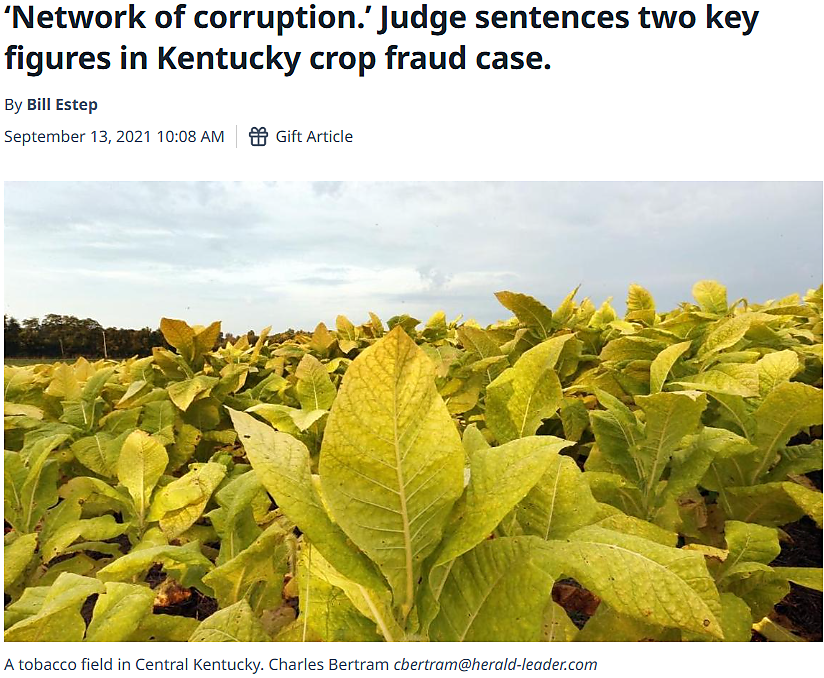
The Kentucky scandals were huge, but North Carolina holds top place in tobacco subsidy fraud. In the late 2000s, investigators uncovered at least $100 million in crop insurance theft, and prosecutors ended up with 41 convictions. The fraud schemes involved multiple crops, but tobacco was front and center. Some of the corruption went on for more than a decade before the government stepped in.
One hub of corruption was insurance agent Robert Stokes, “who pleaded guilty in 2009 to defrauding the government and two private insurers of more than $16 million.” Tobacco was the “centerpiece of his insurance fraud.” Typically, farmers “in the Stokes ring would falsely report poor crops from an insured field, entitling them to an insurance payment, while diverting the actual production for sale under another name.” Stokes would get a cut of the illegal subsidies.
Through prosecuting Stokes, “authorities were led to dozens of others involved in similar frauds throughout eastern North Carolina.” Some of those caught were:
- Jimmy Sasser, an insurance adjuster, was convicted in 2013 of receiving payoffs from fraud schemes over more than a decade. He was ordered to pay $21 million in restitution. After sentencing, Sasser said about crop insurance fraud, “I can tell you it’s everywhere, all across the country.”
- William Rogers, an insurance agent, was convicted in 2013 of helping tobacco farmers defraud the crop insurance program by more than $8 million.
- Tommy Faulkner, a tobacco agent and broker, was convicted in 2012 for helping farmers sell $13 million of tobacco off-the-books in order to file subsidy claims for non-existent losses.
- Harry Canady, a farmer of tobacco and other crops, was convicted in 2012 of $1 million in crop insurance fraud.
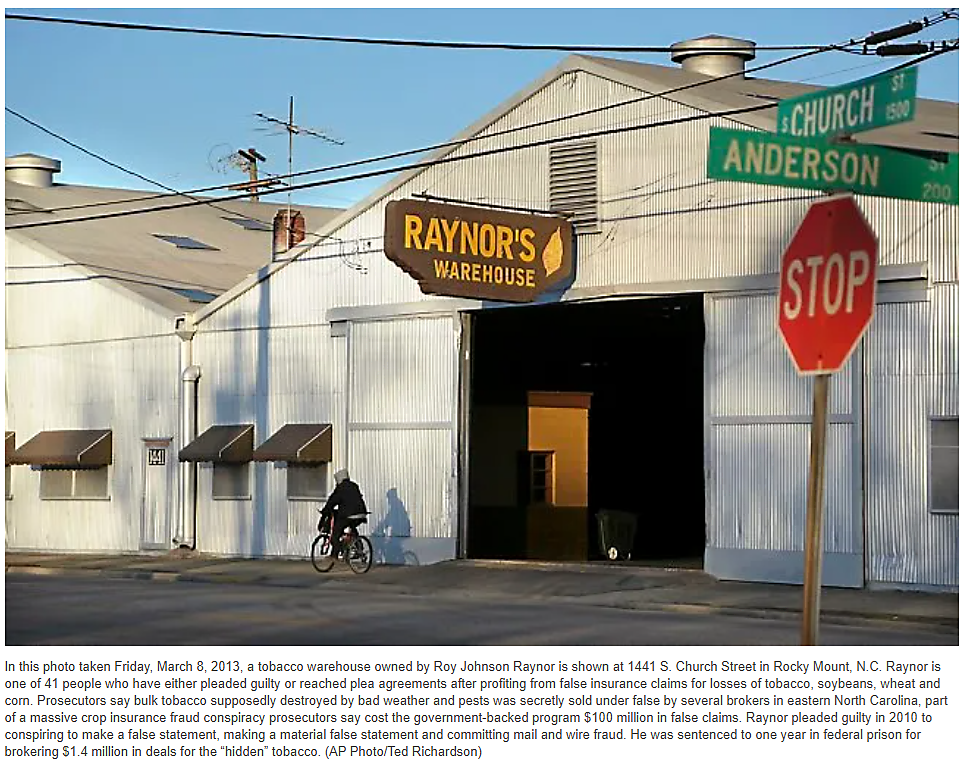
- Roy Raynor, owner of a tobacco warehouse, was convicted in 2010 of aiding farmers in defrauding crop insurance by $1.4 million.
A lead investigator in the North Carolina cases, Don Doles, said that $100 million was only what the government clawed back in fines and forfeitures, but that the crimes were “much larger… I’d say $100 million was a drop in the bucket compared to what really got stolen.” He noted that many scammers got away unprosecuted.
In Minnesota, the recent eruption of welfare fraud spread within a particular community, the Somali community. People appeared to learn how to steal government benefits from their friends and neighbors. A similar thing happened in these farm subsidy scandals. One corrupt warehouse owner or insurance agent convinces one farmer to cheat on his claims, and then other nearby farmers start thinking, “Everyone else is doing it, so I should too.” Cheating on government benefits can become part of an area’s local culture.
One of the prosecutors in the North Carolina cases noted, “The system has checks and balances in place … The problem is all the checks and balances here were involved in the fraud. The adjusters were paid off. The agents were paid off. Everybody was paid off.” Don Doles noted similarly, “It went so far beyond farmers … It was tobacco buyers, tobacco company officials, bankers, check cashers, adjusters, and chemical salesmen. Kind of a giant, tangled web.”
In sum, government subsidy and benefit programs can generate organized crime that permeates communities. So how do we tackle it? In the case of farm subsidies, that’s easy. Farm subsidies are unjust, unneeded, and unaffordable. Fraud is just one of the many reasons why they should be repealed.