

Adam N. Michel and Santiago Forster
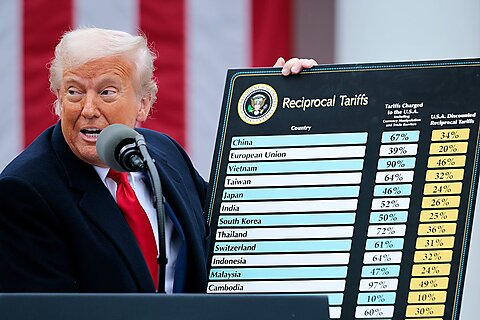
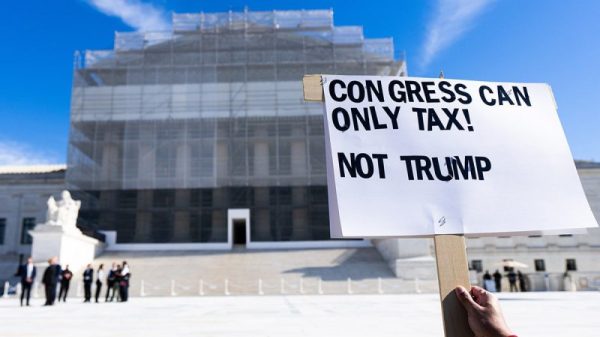
The Supreme Court of the United States (SCOTUS) struck down President Donald Trump’s so-called “reciprocal tariffs” enacted under the International Emergency Economic Powers Act (IEEPA).
The tariffs modestly increased revenue but did not meaningfully improve the government’s long-term budget outlook. They reduced economic growth, shrank other sources of tax revenue, and offset a substantial share of the administration’s signature tax reforms.
Below are four charts that put these effects in context.
High Tariff Revenues Miss Administration Claims
The federal government collected $264 billion in total tariff revenue in the 2025 calendar year (Figure 1). That amount is more than triple the $85.6 billion collected by the Biden administration over the same period in 2021 and far exceeds the comparable $35.2 billion from Trump’s first term.
Importantly, not all of that revenue was generated under the IEEPA authorities. According to US Customs and Border Protection data for fiscal year 2025, which ended in September, IEEPA tariffs accounted for about 60 percent of all duties collected. The remainder reflects tariffs imposed under other statutory authorities that are unaffected by the Court’s decision.
Even at over a quarter-trillion dollars, 2025’s tariff revenue falls well short of the administration’s claims. Treasury Secretary Scott Bessent projected that tariffs could raise as much as $500 billion per year, implying collections roughly twice those reported in official data. Even those figures overstate the budgetary benefit, because tariffs partially offset themselves: higher input costs reduce business profits and worker pay, shrinking the corporate and individual income tax base, while broader economic effects of slower investment and hiring can further depress other revenue sources.
Deficits Continue to Grow With or Without IEEPA Tariffs
Even with tariff revenues at a century high, deficits are projected to continue to increase.
Figure 2 shows projected deficits under current law, which assumes all legislation is executed as written, with temporary provisions expiring on schedule, including significant temporary tax cuts passed last year. According to the Tax Policy Center estimates, the IEEPA tariffs are projected to raise more than $2 trillion in additional revenue over the next decade. Including changes in interest expense, the additional revenue would reduce cumulative deficits by roughly 7 percent over the same period (from $24.8 trillion to $23.1 trillion). Without IEEPA tariff revenue, deficits are, on average, less than half a percentage point of GDP larger, but this does not alter the underlying trajectory of the continuously widening deficit.
The United States’ budget is on an unsustainable path, driven by automatic spending that’s projected to increase faster than the economy, inflation, and the population. As spending rises and revenues remain flat, the deficit increases. The Treasury estimates that more than 95 percent of the government’s long-term funding shortfall is driven by growth in just two programs: Medicare and Social Security. Additional revenue, from any source, cannot fix these spending-based drivers of the long-term fiscal imbalance.
Historically, Tariffs Have Not Been a Significant Revenue Source
History underscores the difficulty of using tariffs to fix the federal budget. Tariffs have never financed a government remotely as large as today’s. In the 19th century, when tariffs accounted for most federal revenue, the federal government itself spent less than 3 percent of GDP. Today, federal spending is 23 percent of GDP.
As Figure 3 shows, tariff revenue averaged 1.5 percent of GDP between 1820 and 1910, fluctuating between 2.7 percent at its peak in 1826 and then 0.4 percent at its low in 1843. After the introduction of the income tax in 1913, tariffs steadily declined as a share of federal revenue. A decade before the second Trump administration, customs duties accounted for less than 2 percent of federal revenue, which is less than 0.2 percent of GDP. In fiscal year 2025, tariffs made up roughly 3.7 percent of federal revenue, which is 0.6 percent of GDP.
This historical record also puts to rest claims that tariffs could replace major components of the federal tax code. Replacing the income tax, for example, would require roughly $2.2 trillion in annual tariff revenue, implying an across-the-board tariff of about 80 percent on all imports, far beyond anything ever proposed or sustained. Even the most optimistic academic estimates suggest tariffs could raise at most between $400 billion and $500 billion per year, less than one-fifth of current income-tax collections and well below the scale needed to finance the modern federal government.
Higher tariff rates do not translate into proportionally higher revenues because, as the tax rises, consumers buy fewer imports, businesses shift to higher-cost domestic alternatives, and reduce production. This dynamic response limits how much revenue tariffs can realistically generate.
Tariffs Offset the Benefits of Trump Tax Cuts
One way to understand the effects of the administration’s trade actions is by comparing them with the tax cuts in the One Big Beautiful Bill Act (OBBBA). Tariffs raise the domestic price of imported consumer goods and manufacturing inputs, which functions as a tax on US consumers and producers. Estimates from the Tax Policy Center show that this amounts to a roughly $ 2,600-per-household tax increase in 2026 (for all announced tariffs from January 20, 2025, through December 4, 2025).
Those tariff costs offset a majority of the average $3,736 tax cut Americans are projected to receive in 2026 from the OBBBA. Considering both policies together, Figure 4 shows that the bottom two income groups face a net tax increase, decreasing their after-tax income by between 1.2 percent and 0.3 percent. Middle- and higher-income Americans see small net tax cuts of between 0.3 and 0.6 percent of after-tax income. Overturning the IEEPA tariffs will allow more Americans to fully benefit from the 2025 tax cuts.
The same tension appears in the macroeconomic effects. The OBBBA is projected to raise long-run GDP by about 1.2 percent, but Trump’s tariffs are expected to reduce GDP by roughly 0.8 percent. Taken together, the net effect is a muted 0.4 percent increase in output, with tariffs significantly eroding the growth benefits of the underlying tax reform.
Conclusion
The Court’s decision will have wide-ranging economic and political implications for trade policy and executive power. But it also brings important fiscal consequences. The administration has repeatedly overstated the budgetary impact of the tariffs, yet the effects are not trivial. Tariffs are, after all, an economically costly, revenue-raising tax on American consumers. Relief from the IEEPA tariffs will benefit American consumers, but risks remain that the administration will pursue similar levies through other statutory authorities.